How to prune a Norfolk Island pine bonsai? Detailed methods and techniques
The Norfolk Island pine (Araucaria heterophylla) is a highly ornamental plant with very strong vitality, usually evergreen year-round, and also a great helper for purifying the air, helping humans improve the air environment, so it is often suitable for care indoors in insufficient light and prefers warmth.
Large Norfolk Island pine bonsai have a majestic momentum, while small ones have their own delicacy, so the ornamental value of the Norfolk Island pine is innate. Under normal conditions, there is no need to prune the branches of the Norfolk Island pine; let it grow naturally. The suitable growth temperature is 10-25°C, and the overwintering temperature is above 5°C. During the overwintering season, some light can be given, the potting soil should not be too dry, and on clear days water should be sprayed to increase humidity.
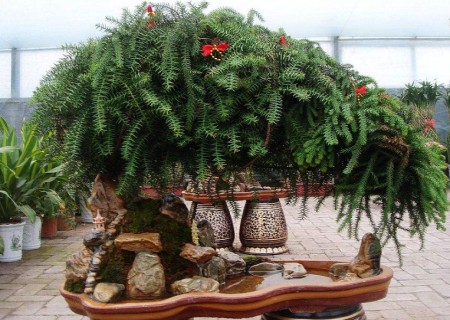
If the Norfolk Island pine grows too luxuriantly, you can prune it appropriately according to your own preferences. Pruning of the Norfolk Island pine can be done in spring, in April or May, at the same time as repotting, and soon you will see tender green new leaves emerge, with high ornamental value.
The Norfolk Island pine is often used to make root-exposed rock-attached bonsai:
1. After buying it, choose beautiful mountain stones; among them, Lingbi stone is resistant to weathering, and water-absorbing stone helps maintain the plant. Choose stones according to your own preferences.
2. Move the Norfolk Island pine into the ground, or use a tall flower pot. Tidy the root system and embed the stone. Prune reversed roots, straight roots, and diseased, weak or dead roots.
3. After tidying the root system, bind it close to the stone with cotton yarn, not too tightly, to avoid blocking the roots' absorption. Fill with soil and bury up to the root crown.
4. At the top, keep an odd number of main branches such as three, five, or seven, for wiring and pruning, layering them and separating primary from secondary.
5. After a period of growth, gradually scrape away the soil layer to slowly expose the root system; by then the roots have already firmly grasped the stone.
In this way, a beautiful Norfolk Island pine root-exposed rock-attached bonsai is completed.
For beginners, buy a small seedling that is one year old or a two-year-old cutting, about 20-30 cm tall, pair it with a pot you like, and if interested, prune it appropriately, add a small delicate stone, and ornament it with one or two small decorative pieces; it becomes a small and lovely tree bonsai, and placing it indoors for long-term viewing is truly elegant. If your budget allows, you can buy a Norfolk Island pine rock-attached bonsai for one or two hundred yuan.