How to Propagate Osmanthus by Layering? A Full Breakdown of Methods and Steps
Layering propagation makes use of the habit of branches rooting when they come into contact with soil: part of a branch or its stem is buried and pressed into the soil to let it root, and it is then separated into an independent plant. Layering is one of the many methods of flower propagation; it involves pressing and burying the lower branches of the mother plant into the soil, prompting the adventitious buds at or between the nodes to sprout and grow new roots, then cutting them away from the mother plant and planting them separately, thus forming a new plant.
Layering propagation is mostly used for flowering shrubs with a strong clumping habit and for vine-like flowering plants with soft branches. For woody flowering plants that root with difficulty, such as Aglaia odorata, Michelia alba, Gardenia jasminoides, and Osmanthus, the air layering method can also be used to let the layered branch root before it is cut from the mother plant, which brings great convenience to flower propagation.
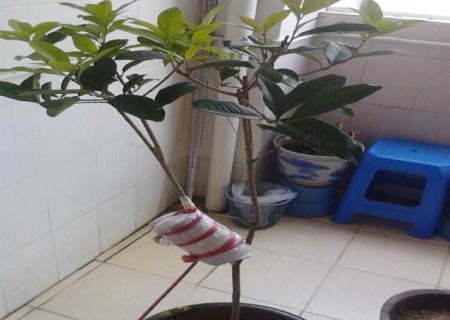
Osmanthus layering propagation can be divided into air layering and ground layering.
1. Air layering
It can be done all year round, but it is better to do it before germination in spring. Air layering is more suitable for home potted plants, and is generally done around Qingming when the temperature is about 20-25°C.
First, on a strong mother plant of a good variety, choose a 2-3 year old branch that will not affect the tree canopy and girdle it; the length of the cut is about 2 cm.
Second, take a section of bamboo split into two halves, spread a layer of sandy, moist potting soil inside, wrap it fully around the girdled part of the branch, wrap the outside with plastic film, and tie it with a strap; after about one month the wound heals.
Third, after 3 months new roots grow from the cortex at the cut; by July open it to check the rooting, and in October or the following spring, when the new fibrous roots have grown 3-5 cm long, it can be cut away from the mother plant. When cutting, be sure to cut at the lower end of the bamboo tube, then replant it in a pot.
2. Ground layering
Also called prostrate layering or ordinary layering, this is the most commonly used method. This method is best done in April-June or August-September (when the temperature is 25-30°C).
1) For clumping plants, the mound layering method can be used: cut the bark on a branch near the root for 1-2 cm, bend it down to the ground, pile soil 7-8 cm high over the wounded branch, firm it down, water frequently to keep it moist, and it will root in about 3 months; in the following spring cut it from the mother plant and plant it as a new plant.
2) For prostrate layering of a single-stemmed plant, choose a vigorous branch and remove some leaves; after girdling it with a knife, press it into the soil, then insert a bamboo fork deep into the soil to fix the branch so it does not spring up or move, cover it with a layer of soil about 10 cm thick, and leave the tip and leaves outside the soil; after it roots in 3 months, it can be cut from the mother plant and planted separately as a new plant. If it is a potted plant, the branch with the cut can be pressed into another pot of soil and fixed, and after it roots it can be cut away and transplanted.
How to propagate Osmanthus quickly by layering? It can be divided into low layering and air layering.
1. Branch layering propagation
For Osmanthus from the end of March to early April, around the mother Osmanthus plant, depending on how many branches can be layered (generally each mother plant can have 4-5 branches layered), dig a small trench 20 cm deep and 20 cm wide along the direction in which the branches naturally extend, press the branches into the trench, fill the trench completely with fertile soil and tread it firm, water thoroughly, and then mound the soil at the layered part into a steamed-bun shape.
For low layering of Osmanthus, a low-branching or clumping mother plant must be chosen. The time is from spring to early summer; choose a fairly thick, low-trunked mother tree, take its lower 1-2 year old branches, choose an easily bendable spot, cut or girdle it with a sharp knife down to the xylem, then press it into a 3-5 cm deep trench, and fix the layered branch with a wooden stick, leaving only the tip and leaves outside.
2. Air layering
To propagate Osmanthus in September-October, split 1 section of moso bamboo tube into two pieces, fill it with wet soil, and fit it around a vigorous branch of a good Osmanthus variety; support it with a stand, add water frequently, and keep the soil in the tube moist; after more than 1 month the branch will grow new roots. The following spring, take down the new roots and transplant them into the ground, and it becomes a vigorous Osmanthus plant, which will bloom after 3 years.
In the air layering method, in spring choose a 1-2 year old thick branch from the mother tree, cut a ring or girdle it as in the low layering method, or make a cut 6-9 cm long on its lower side, then apply culture medium to the wound, tie plastic bags tightly above and below, and during the cultivation process always keep the medium moist; after it roots in autumn, cut it from the mother plant and care for it.