Detailed Guide to Air Layering Propagation for Potted Plants
Woody plants are somewhat more difficult to propagate from cuttings than herbaceous plants. In this issue, the expert often solves this problem perfectly by using air layering to achieve propagation of woody plants. "Air layering" is the short name for high-altitude layering; simply put, it means making a wound on a plant branch, and during the gradual healing process of the wound, roots are produced. In fact, the principle is similar to cuttings, but because this propagation method has a very high success rate and the entire propagation process does not detach from the mother plant, it is treated as a separate and reliable propagation method.
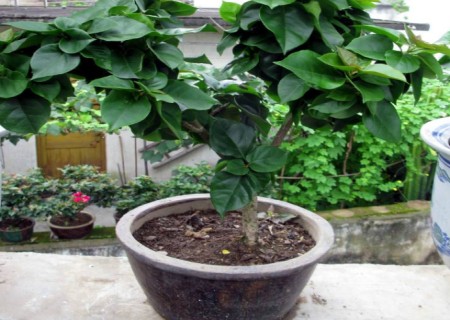
Layering propagation is divided into two methods: air layering and ground layering. Air layering is also called high-altitude layering propagation. Advantages: high survival rate, especially for varieties that are difficult to root from cuttings, for which air layering is suitable; it takes shape quickly and flowers and fruits early. Disadvantages: compared with cutting propagation, the workload is greater. Below is an introduction to plant air layering techniques:
First, do the necessary preparatory work for high-altitude layering, such as containers, bamboo (wooden) poles for support, rope for fixing, and knives for cutting.
Cut and peel the bark at the selected rooting site by about 1.5 to 2 cm. More than 2 cm makes survival difficult, while less than 1.5 cm will not produce roots and will only heal.
Insert the bamboo (wooden) pole used to secure the container into the soil underground, then place and tie the container in position.
To prevent soil loss from the container, place small stones appropriately in the bottom layer of the container.
Pour in plain soil made of appropriately fine sand and soil.
Finally, water thoroughly until water flows out. After that, do not water unless it is dry. Once roots have formed, cut it off and plant it in a pot or in the ground.
Note: Why use a transparent plastic bottle as the container? Because it allows you to directly see the rooting situation at the layering site. Other things can also be used as containers.
Air layering has a high success rate and is suitable for woody plants that are difficult to root from cuttings, such as roses, fruit trees, and woody hydrangeas, and various other ornamental or edible plants. It is especially often used in bonsai shaping to conveniently remove intact branches needed for landscaping. Below is a record of the key points of the process:
1. Prepare tools: girdling knife (I did not have one, so I used a narcissus carving knife instead), tape, mineral water bottle, branch scissors, pen, scissors, growing medium (I used peat; substrates such as sphagnum moss can also be used, and any loose substrate with good water retention is fine), rope (forgot to take a photo).
2. Selection of the branch to be air layered: a thickness of 0.5 cm or more in diameter is best. Here I chose the branch I am holding in my hand, mainly because I wanted to perform plastic surgery on this Serissa japonica, and this branch is relatively strong. It would be a pity to cut it off and discard it directly, and the cutting survival rate is not high either, so I used the air layering method.
3. Preliminary preparation: determine the air layering site, use branch scissors to tidy up the branches, and leave about 10 cm of branch-free area.
4. Use a pen to mark the girdling site for the next step (this step can be omitted), keeping the distance within 1 cm.
5. Use the carving knife to gently cut away the bark and the cambium (the green layer). Note that this is the key to successful air layering. If only the outer bark is cut away and the cambium is not removed, air layering may fail. Rotate and repeat the operation, and be sure to control the force well; do not cut the entire branch off.
6. Cut off the bottom part of the mineral water bottle at a height of about 12 cm, cut it open from the side as shown in the photo, and leave a hole at the bottom slightly larger than the branch.
7. Gently put the mineral water bottle around the girdled branch, and use tape to secure the cut opening, keeping the girdling wound in the middle.
8. Fill with substrate. Because the branch I chose is slanted, I rolled paper into a funnel shape to fill the substrate. Fill the substrate until it completely covers about 2 cm above the girdling cut.
9. Water the substrate thoroughly. Because the branch is curved, I used small bricks as support to keep the mineral water bottle from falling over and to keep the branch centered in the substrate.
10. Use a plastic bag to tie up the upper part to keep moisture from being lost easily.
11. Follow-up management: carry out normal water, fertilizer, and light management for the plant. During this period, pay attention to maintaining the moisture of the substrate. For watering, you can use a syringe to inject water into the upper part, and be careful not to touch the girdled branch, so that the newly grown roots are not torn off. In summer, roots can generally form in about one month.
12. I carried out air layering on May 29, and only transplanted on July 20. With the mineral water bottle, you can clearly see that fine roots have already grown out, and at this time the branch can be transplanted.
13. Gently remove the mineral water bottle, and you can see that many roots have already grown.
14. Use branch scissors to cut off the air-layered branch completely from the lower part, then plant it in a new container and manage it normally.
Supplement: The survival rate of air layering is very high. As long as you pay attention to the small details, doing air layering in the three seasons of spring, summer, and autumn gives a 100 percent survival rate. Hehe, are you eager to try it? Hurry up and perform surgery on the woody plants in your home.