Detailed Explanation of Air Layering Propagation Techniques for Plum Blossom and Key Operation Points
Potted plum blossoms are mainly propagated by grafting, commonly using cut grafting and bud grafting. The rootstock is wild peach, mountain peach or apricot. The old trunk bark of apricot is red; when grafting red plum blossom onto it, the flower and bark colors harmonize. However, when the propagation quantity of plum is not large, the layering method can be used.
Layering is a traditional method of propagating plum blossom. It is best done in early spring from February to March, selecting vigorous 1-3 year old long branches, digging a trench beside the mother tree, and at the lower part of the bend of the branch, notching or girdling the branch (0.5-1 cm wide, deep to the xylem), pressing it into the trench, then covering with soil, and after rooting, gradually cutting it away from the mother tree.
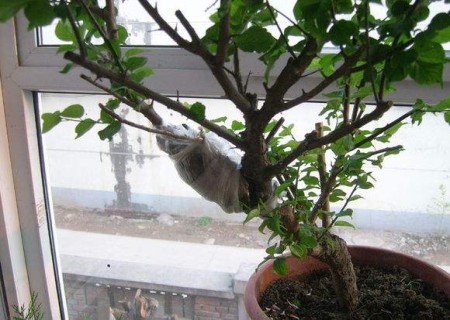
I want to air layer a few plum blossoms and change the rootstock. The branches to be air layered are as thick as a chopstick, and there is also a Green Calyx plum whose main trunk is too tall, 3-4 cm thick, which I want to air layer to replace the peach rootstock. What should I pay attention to?
Air layering can be done during the plum rain season. On the mother tree, select a suitable branch and slightly notch it, wrap some mixed soil with plastic film, tie both ends tightly, maintain temperature and keep the soil moist. Roots will form in 2-3 months, and generally after autumn the mother body can be cut, and it becomes a new plant on its own.
Check after one month. Those that have rooted can be cut with an incision below the layer, reaching halfway deep, and after another 20-40 days they can be completely cut away from the mother body and moved to the field for cultivation.
The air layering method can also be used to propagate large seedlings. In the plum rain season, select a suitable branch from the mother tree, notch or girdle it, then wrap mixed soil with a plastic bag, tie both ends tightly, maintain humidity, and after one month check whether roots have formed. After rooting, cut it off below the incision and transplant it for cultivation.