How to propagate Podocarpus macrophyllus by air layering? Detailed method and steps
Podocarpus macrophyllus has an elegant and upright charm, with a powerful and vigorous proud momentum. Combined with meanings in Chinese culture such as “longevity” and “keeping wealth and good fortune,” owners pursuing high-grade courtyard landscaping often like to plant one or two Podocarpus macrophyllus, adding a brilliant touch to their own “garden-style story.” As a slow-growing tree species, Podocarpus macrophyllus itself cannot be quickly replicated, especially large, beautifully shaped Podocarpus macrophyllus, which is even harder to find. It is understood that engineering seedlings with a diameter at breast height of more than 10 cm on the market mainly rely on imports.
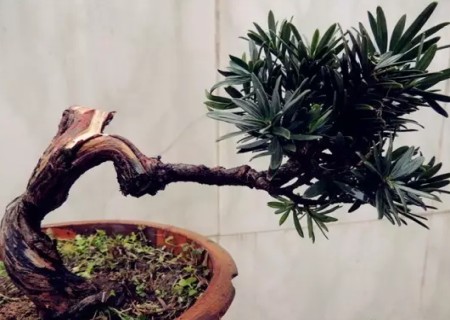
For Podocarpus macrophyllus, prepare a 2 cm ring-barking site. Can air layering be used? In fact, air layering is possible. Generally, after the weather warms up in early spring, either air layering or cuttings can be started. What needs attention is the balance of supply and demand in the plant. It is best to use strong young branches, which grow faster. Remove most of the branches and leaves and keep a small amount. Cultivating them in a sand bed for rooting is relatively fast. Pay attention to shading and moisture retention. Rooting generally occurs in about 2-3 months.
Air layering is a good way to quickly obtain material. Compared with cutting propagation, air layering can shorten the time and is the best choice for ordinary enthusiasts.
The principle of air layering is to use the plant cambium to produce callus tissue when it is damaged or stimulated, and this tissue has regenerative ability and can fill in what the plant lacks, such as xylem, phloem, roots, stems and other tissues.
By ring-barking the branch, the cambium will be destroyed, thereby forming healing tissue. For the upper part of the plant, there are no roots, so the healing tissue will be triggered to grow roots.
Because the plant's water is transported through the xylem, as long as the lower mother plant below the ring-bark grows normally, it can normally supply water to the upper air-layered plant, and death will not occur, so the success rate is relatively high.
However, there are still some issues to note:
First, the length of the ring-bark must not be too small. For those fast-growing varieties, it is easy for the upper and lower parts to heal together again, failing to achieve the purpose of rooting: [the goal of rooting].
Second, the more vigorously the upper air-layered plant grows, the more organic matter it accumulates. When transported downward to the healing tissue, the more energy will accumulate there for rooting, which will speed up root emergence. Therefore, the upper part usually needs to have sacrifice branches left, and air layering is also usually carried out in spring and summer when the plant grows rapidly.
Third, because the phloem of the lower mother plant is cut off, it cannot obtain organic matter. If the time is too long, it will be exhausted, leading to being “starved to death” and root rot. In this way, not only will the mother plant die, but the air-layered plant will also be unable to obtain water and will also die, thus all previous efforts will be wasted. Therefore, the way to solve this problem is either to use independent small seedlings on the mother plant to supplement branches and provide organic matter, or to first use independent small seedlings on the air-layered plant to supplement roots and provide water. In this way, everything can be ensured.