Detailed Explanation of the Operation Method for the Bark-Grafting Tongue Approach Technique on Pear Trees
Grafting is the artificial joining of tissues such as a branch or bud from one plant onto a suitable part such as the branch, trunk or root of another plant, so that they heal and grow together to form a new plant. This branch or bud is called the “scion”, and the plant that bears the scion is called the “rootstock”.
When grafting, if the scion is a branch it is called “branch grafting”; if the scion is a bud piece it is called “bud grafting”. During the period from the beginning of bud break on the rootstock until leaf expansion, spring grafting can be carried out, including bud grafting and branch grafting; from the start of semi-lignification of the new shoots of the rootstock, summer bud grafting or green-branch grafting can be carried out; before the new shoots of the rootstock stop growing in autumn, autumn bud grafting can be carried out; in winter, root grafting can be carried out, with stratification in sand over winter for healing, and planting out the following year.
For grafting pear trees, after the rootstock has become semi-lignified in summer, it is best to use “square” bud grafting, tying with the bud exposed; after the rootstock begins to sprout in spring and before leaf expansion, it is best to use “bark-grafting tongue approach”, and both methods require leaving a good “drainage (bleeding sap)” opening.
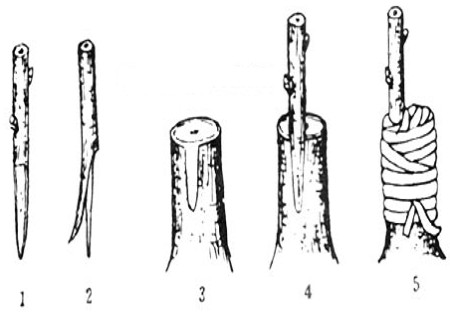
Bark-grafting tongue approach technique for pear trees:
It is improved on the basis of bark grafting. The suitable period for grafting is when the bark of the rootstock and scion slips easily.
1. First, cut the scion into a large tongue-shaped cut surface about 4-5 cm long.
2. Pinch open the bark layer of the tongue-shaped part with your fingers to separate it from the wood.
3. Cut off the rootstock at the part where grafting is needed, then on the smooth-barked side of the rootstock scrape off a layer of outer bark about 5-6 cm long and slightly wider than the scion.
4. Then insert the tongue-shaped woody part of the scion between the bark and the wood of the rootstock, lay the bark of the scion over the cut surface on the outer surface of the rootstock, and leave about 0.5 cm of the cut surface exposed.
5. Finally, wrap tightly and completely with plastic strips.