A detailed guide to the side-grafting technique for pear trees: master the key operation points
For grafting pear rootstock, I use "T"-shaped budding; for thicker suckers, side grafting or cut grafting can be used. For pear seedlings after transplanting and grafting, because the density in the sowing bed is relatively high, growth is often uneven, so it is best to plant out the grafted half-grown seedlings separately before spring growth the following year.
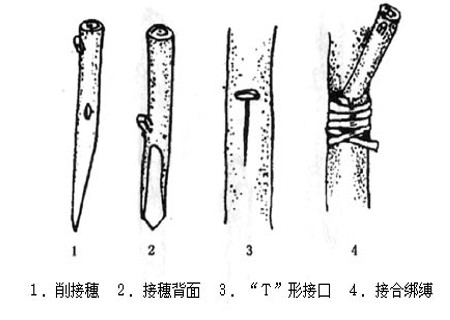
Side-grafting technique for pear trees:
It is mostly used to fill in gaps in the plant, generally by grafting onto bare areas of branches and trunk to increase the amount of inner-canopy branching and fill space. When grafting, first cut a T-shaped incision in the rootstock bark, reaching deep into the xylem. On the bark above the horizontal cut, shave a triangular or semicircular slope to make it easier to insert the scion and fit it tightly. The incision site is generally on a slightly raised place or on the outer side of a bend. When the rootstock is upright or relatively thick, a slightly slanted T-shaped incision is better. The side-graft scion should preferably be slightly longer, slightly thicker, and somewhat curved.
Select 1-year-old vigorous growing shoots as scions. Leave 2 to 3 plump buds on each scion segment. With a knife, first cut a long cut surface 3 to 5 cm long at the lower part of the scion; the cut surface must be flat and straight. Then cut a small cut surface 1 to 1.5 cm long on the opposite side of the cut surface, so that the lower end is slightly pointed. Leave 2 to 3 buds on the upper part of the scion; the terminal bud must remain on the back side of the long cut surface. The cut surface must be smooth. Cut off 0.5 cm above the bud. At the grafting site on the rootstock, cut diagonally downward with a knife, reaching 1/3 to 1/2 deep into the xylem, then quickly insert the long cut surface of the scion into the rootstock cut so that the cambium layers align, and wrap it tightly with plastic film. There are also bark side grafting and side grafting with a base branch, mainly used for grafting Chinese chestnut.