Key Points and Detailed Operation Methods of Softwood Grafting on Pear Trees
Grafting is a propagation method in which a branch or bud from one plant is attached to the branch, trunk or root of another plant so that they form a new plant. The nursery stock produced by grafting is called a grafted seedling. The branch or bud used for grafting is called the scion, and the plant that bears the scion is called the rootstock.
Grafted seedlings can maintain the characteristics of a superior variety (the scion), and they grow quickly, have a strong tree vigour and bear fruit early; therefore, they help accelerate the promotion and application of new varieties. By making use of certain characteristics of the rootstock, such as drought resistance, cold resistance, waterlogging tolerance, saline-alkali tolerance and pest and disease resistance, the adaptability and stress resistance of cultivated varieties can be enhanced, so as to expand the cultivation range or reduce production costs. In the production of fruit trees and ornamental plants, the rootstock can be used to regulate tree vigour, making the tree dwarf or standard, so as to meet different cultivation or consumer needs. Most rootstocks can be propagated from seed, so the propagation coefficient is large, which makes it easy to promote and plant them on a large scale in production.
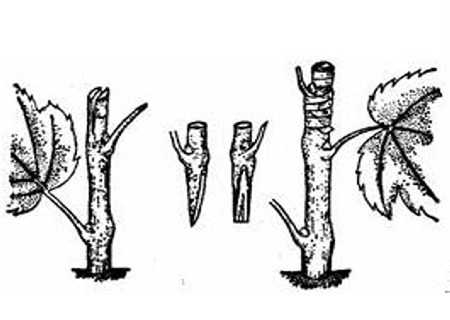
Softwood grafting technique for pear trees:
Softwood grafting is a method of branch grafting that uses semi-lignified softwood shoots that have sprouted in the current year as the scion. The rootstock is mostly softwood shoots. It is often used for grapes and is carried out during the growing season. It can be done from early May to mid-to-late August, but earlier is better.
Use a sharp blade to cut the scion into single-bud segments and place them in a bucket of cool water to keep them moist. When grafting, make a flat cut 2-2.5 cm above the bud, and at 0.5-0.8 cm below the bud cut downward from both sides of the bud to form two slanted cut surfaces 2.5-3.0 cm long. Cut off the new shoot of the rootstock at an internode 20-30 cm along, and make a vertical cut 2.5-3.0 cm long downward in the centre. Insert the scion into the cut in the rootstock so that the cambium layers of the two are aligned, then wrap the graft union with a plastic strip, leaving only the grafted bud exposed.