Pine bonsai grafting method illustrated, step by step teaching you how to do it
Grafting can improve quality and enhance ornamental effect, so grafting is also often used in bonsai creation. For deciduous tree bonsai, because the raw material has strong sprouting ability, the first cut after collection is usually to shorten an overly tall trunk, using ideal side branches on the stump base to cultivate a new trunk, carry out dwarfing, and condense it into a scene in a pot. But for mountain pine with a naturally beautiful stump base yet a tall trunk and thin branches, the trunk cannot be cut short for dwarfing. Using grafting to “change the crown” and turn ugliness into beauty is a good method for creating this type of mountain pine bonsai.
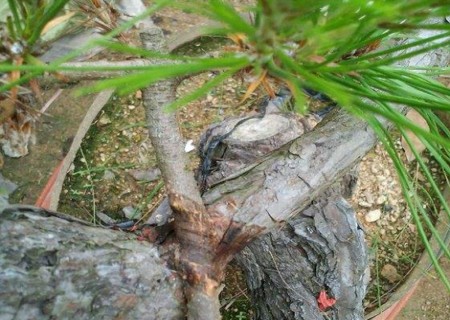
The beauty of mountain pine bonsai lies in its thick scaly bark, but precisely because of this, plus the abundant resin, grafting is more difficult than with deciduous trees. Therefore, for mountain pine bonsai grafting, the tree must first be grown strong, allowed to grow wildly, and the grafting branches cultivated into “fat branches” before grafting can be carried out. In Wuzhou mountain pine bonsai grafting, approach grafting and seedling-threading grafting are mostly used. There are two types of approach grafting: one is cultivating small seedlings for approach grafting, and the other is approach grafting with branches. Approach grafting with branches also includes approach grafting with branches on the original stump and approach grafting with branches between potted trees.
The main grafting methods for mountain pine are as follows:
1. Cultivating small seedlings for approach grafting. 2. Approach grafting with branches on the original stump and approach grafting with branches between potted trees. 3. Seedling-threading grafting. 4. Trunk-threading approach grafting.
The specific grafting steps/methods are as follows:
1. Select the grafting scion, about 10 cm.
2. Remove the needles from the lower part of the scion about 2 cm from the tip.
3. Use a cutting tool to make a flat cut in one motion on the end where the needles were removed. Do the same on the other side, while making the opposing cuts basically symmetrical.
4. Make a small opening in advance on the trunk or branch of the old mountain pine stump, with a size suitable for the scion insertion.
5. Insert the previously prepared scion into the small opening just made.
6. Wrap plastic film around the grafted point where the scion was inserted.
Grafting time should be in the growing season. Before grafting, the old bark at the grafting site on the old branch must be peeled off. The operation must be accurate and quick, and the binding must be firm to prevent tree sap (resin) from solidifying and forming a thin film that blocks cell penetration and growth. After binding, a dual-purpose sealing glue can be applied or adhesive tape film can be used for wrapping to prevent water loss. Once success is confirmed, gradually wean it off, and only completely separate it in the second year's growing season.
In Guangdong, trunk-threading approach grafting is also used. The method is to drill a vertical hole at the position where a branch emerges on the trunk, remove the needles from the front end of a branch of roughly the same diameter while keeping the bud tip, thread it through the hole, press the cambium layers tightly on one side, then bind and fix it. The effect is also very good.