How to Prune and Needle-Control Mountain Pine Bonsai? Detailed Methods and Techniques
Mountain pine, also known as Masson's pine, is a common tree species in the Lingnan region and one of the famous species for making bonsai. Its vigorous, majestic, rugged and ancient-looking trunk, sturdy and upright, evergreen and verdant, is gradually gaining the attention and affection of bonsai enthusiasts. Masters through the ages have often produced outstanding works, and it is deeply welcomed by bonsai lovers.
However, its needles tend to be long, reaching about 25cm under natural growth, and are not firm enough. After being battered by strong winds for a long time, they appear messy and droop softly, seriously affecting the shape and ornamental effect. Therefore, controlling the length of the pine needles is an objective problem. In the past, some people controlled water and fertilizer to shorten the pine needles, but the results were not ideal. How to shorten its needles (needle control) has become an important part of making Masson's pine bonsai.
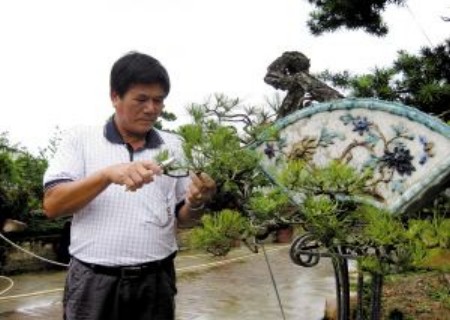
Under normal growth in the Lingnan region, mountain pine sprouts new buds twice a year, in March and August (this may vary by region or due to growth vigor and climate change). For transplanted and successfully established stumps, after cultivation and bud forcing, once the tree's framework has taken shape and the branches are relatively dense, and the stump bonsai has initially entered maturity, needle control can be carried out to improve the ornamental effect.
The method of needle control is to perform synchronized comprehensive shortening pruning on all branch claws according to the crown styling requirements. The best time is when new buds begin to sprout, as the sap is flowing and the growth burst is strong, which helps stimulate clustered buds. After pruning the branches, at least four bundles of needles must be left to prevent needle loss and branch loss. For individual ones not suitable for shortening, the terminal bud tips should also be removed to achieve synchronized sprouting.
After pruning, there is no need for shade. After about twenty days, each pruning cut will certainly sprout multiple new buds, forming clusters. If the tree is vigorous, one pruning cut can sprout more than ten buds. After pruning, strictly control water and fertilizer. When the new buds release needles and the needles grow to about 2cm, remove (or cut) all the old needles at once, and the ornamental effect will initially appear. After three months, the needles will grow to 4cm-5cm. At this point, the growth period has basically reached its limit, and the needles will no longer grow. The delicate, emerald-green needles contrast strongly with the rugged, bony trunk, combining strength and softness, with a distinctive charm, fully displaying the unique characteristics of Masson's pine seedling information bonsai. If handled well, it can be enjoyed continuously for more than four months.
During the needle control process, attention must be paid to cultivating the tree's vigor. In the early styling stage of mountain pine bonsai, no matter what styling method is used, attention must first be paid to cultivating branch pads and forcing buds for styling. As long as growth is normal and the soil is loose, dilute fertilizer can be applied frequently. Fully fermented cake fertilizer, shell fertilizer, or fish fertilizer, mixed with more than twenty times water, can be applied in appropriate amounts monthly during the growing season to let the tree grow rampantly, aiming to build up the tree's vigor, loosen the branch cortex, and thicken quickly, which facilitates wiring or bud forcing to form multi-level branches and shortens the time to completion. Once the branches and trunk have taken shape, the branch claws are full, and the tree is vigorous, needle control can be carried out.
During the needle control process, several issues must be noted:
1. Building up tree vigor
In the early styling stage, no matter what styling method is used, attention must first be paid to building up the tree's vigor (branch pads) and forcing buds for styling. Once the branches and trunk have taken shape, the branch claws are full, and the tree is vigorous, needle control can be carried out.
2. Mastering timing
Shorten-prune three months before the viewing period. For example, for “May Day” viewing, shorten-prune in early February; for “National Day” viewing, shorten-prune in early July. If shorten-pruning after late autumn, leave enough three months of growth period according to the regional climate. Unless there are special needs, the best time for needle control is when the bud tips are just beginning to sprout.
3. Synchronized shortening pruning
Each time you shorten-prune, generally retain a certain number of needles to avoid excessive physiological imbalance between roots and leaves. The pruning cut should preferably be chosen where the needles are denser, and best cut at the growth internode of the second sprouting. For new branches that have not yet lignified, the new buds after pruning will grow singly and leggily, making needle control difficult.
4. Timely bud thinning
After pruning, most of the needles are cut off, and the physiological balance between the plant's branches and leaves and the root system is greatly affected. In addition to strictly controlling water, part of the root fibers can also be pruned. The needles retained after shortening pruning will, through photosynthesis, adapt to the physiological needs of the root system and transport nutrients to promote new buds. After the new buds sprout, the original needles can still strengthen photosynthesis. At this time the bud tips are clustered, but extremely tender and fragile. Avoid impatience, premature, or arbitrary bud pinching and leaf removal.
5. Removing old leaves
Only when the new buds have released needles and grown to about 2cm may some overly dense or poorly developed weak bud tips be gradually and appropriately pinched off, so that the new buds grow evenly. Cut off all the original old needles (pulling by hand easily takes away the new buds in the leaf axils at the same time) to control the new buds' needles from growing too quickly.
6. Controlling water and fertilizer
Too wet potting soil easily causes root rot, while too much fertilizer can cause nutrient backflow or burn the root system, often ultimately causing death. Therefore, in the early stage of needle control, fertilizer must be prohibited and water controlled, and the potting soil must be kept on the dry side. After the new buds sprout, watering can only be gradually restored to normal, and no fertilizer may be applied. If the needles appear too weak or yellow, ferrous sulfate and fish fertilizer, or other foliar fertilizers, may be appropriately sprayed on the leaves, but alkaline fertilizers and nitrogen fertilizers should not be applied.
7. Combining needle control with free growing
After whole-plant shortening pruning for needle control, its physiological balance is bound to be disrupted. The plant's self-regulation will discard some root fibers, or even part of the root system, causing slow growth during the growing period. Removing old leaves noticeably weakens its vigor, so it must be given sufficient opportunity to rest and recuperate, with careful care. After the growing period has passed, when the new buds have lignified or not yet lignified, carry out comprehensive bud thinning and free growing. At this time, according to styling needs and in combination with branch claw positioning, leave only two bud tips (new branches) at each pruning cut and cut off all the rest.