Detailed Guide to Propagating Elephant Ear (Alocasia) by Stem Cutting
Elephant ear (Alocasia) easily immerses people in a warm dream, many people love its large, fat, emerald-green leaves and enjoy watching water droplets roll on the leaves, so after being grown in water in a large container it is suitable for placement in a corner of a hall, living room or leisure bar. Small or mini water-grown elephant ears can accent a desk, computer desk or washbasin counter.
The benefit of cutting the stem is that, because the plant loses its apical growth dominance, nutrients accumulate at the base, prompting the roots and stem base to sprout in large numbers, which helps propagation speed and propagation quantity.
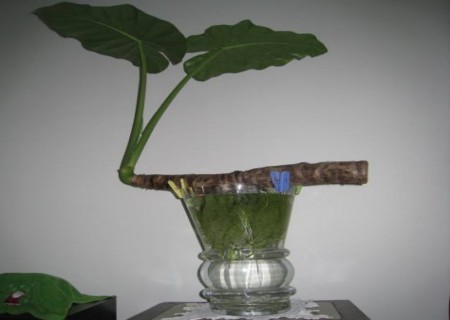
First, cut the stem at about 5 cm from the plant base above the soil surface;
Second, the cut old stem can be cut into segments about 15 cm long, left to air-dry in a shady place for half a day, and then inserted into sandy loam soil for cultivation. Especially the top section that is still growing: after cutting off all formed leaves, pot it directly as a single plant, carrying out cutting and cultivation simultaneously; after two months of growing it becomes a finished plant with large leaves, dense branching and a short, sturdy, vigorous form, and placed indoors it has a certain elegant charm. Cutting and inserting elephant ear (Alocasia) can be done in all three seasons of spring, summer and autumn.
During the cutting period, keep the substrate (6 parts sand : 4 parts garden soil) moist, and at the same time increase air humidity; in about 7-10 days many sturdy roots will grow. During the cultivation of the old plant, because of the shady, humid environment or because the leaf surface is misted every morning and evening in summer and autumn, a few new plants occasionally sprout on the old stem (especially on the stem base left after the stem-cutting treatment), and many aerial roots attach to it; you can twist them off from where the daughter plant meets the mother plant and pot them for planting.
How do you propagate elephant ear (Alocasia) by stem cutting?
Cut the stem at 5 cm above the plant base and propagate by cutting. Stem cutting can be done in all three seasons of spring, summer and autumn. The cutting substrate is mixed from river sand and vegetable garden soil at 6:4. During the cutting period, raise the humidity and keep the substrate sufficiently moist; in 7-10 days sturdy roots grow. Below are the specific operation methods:
1. Selection of the plant
(1) Directly take a potted plant and wash it; especially one with many stem branches and a beautiful plant shape, the elephant ear (Alocasia) is the best material for water growing.
(2) Cut the stem at about 5 cm from the plant base above the soil surface, and carry out stem cutting to promote rooting.
(3) Take the small leaf-bearing elephant ears (Alocasia) that sprout around the tuber.
(4) When the fruit ripens after autumn, harvest the orange-red seeds and sow them immediately after harvesting to form small plants.
2. Matching of pots and vessels
Small and medium plants are matched with small and medium glass vessels of various shapes.
Wider, larger plants are matched with low, wide glass containers of various semicircular or fish-tank shapes.
Tall, slender plants are matched with deep, straight cylindrical glass bottles.
3. Care and management
(1) The stem and root tissues of the elephant ear (Alocasia) are relatively loose and have high requirements for water quality; be careful to keep the water clear and hygienic, otherwise the stem and root system easily rot.
(2) In hot summer, increase the frequency of changing the water, and require air humidity of no less than 60%. Mist frequently to create a relatively cool and moist environment for it. In winter, to keep its leaf colour deep green, generally mist with warm water once a week.
(3) The water level just covering 2/3 of the root system is enough; often clean the inner wall of the container to avoid the growth of blue-green algae.
(4) The sap in the stems and leaves of the elephant ear (Alocasia) is toxic; take care during care and management, it must not enter the mouth, and contact with the skin causes itching and red swelling, so rinse promptly with water, or wear plastic gloves when handling to be safer.