How to divide Asparagus fern (Asparagus setaceus): illustrated steps and precautions
Asparagus fern has an elegant form, with heights arranged in order and a quiet, refined charm, giving it high ornamental value. Its stems are jointed like bamboo and carry the graceful, unrestrained bearing of bamboo, which is why it is called "wenzhu" (literary bamboo). Its leaf-like branches are slender and beautiful, densely growing like feathers, with layer upon layer of emerald cloud, an elegant plant shape and a distinctive charm. It is deeply loved by people and is a famous indoor foliage plant.
Asparagus fern is mainly grown in pots for its foliage. It is fresh and quietly elegant, and placed in a study it adds even more of a scholarly atmosphere. Its branches and leaves are slender, upright and beautiful, with an even balance of dense and sparse emerald green and a graceful bearing, making it a good accompanying material for cut flowers, bouquets and flower baskets. Slightly larger potted plants can be placed on a windowsill; large potted plants can be given a support frame so their leaves are evenly distributed, and can be displayed in a corner.
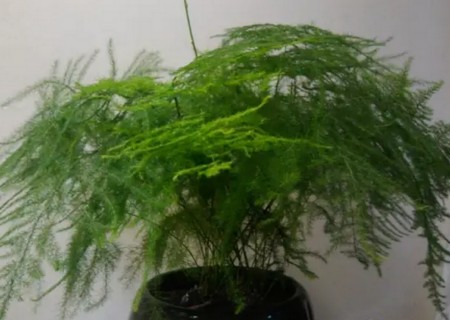
There are many friends who love asparagus fern. Although asparagus fern is not bamboo, its stems are jointed like bamboo and its bearing is very beautiful. Many friends who grow asparagus fern do not know how to propagate it. Today Huahua will explain how to turn one pot of asparagus fern into two pots.
In terms of its characteristics, asparagus fern has a very strong clumping habit. After 4 years or more, asparagus fern will sprout new tiller shoots at the root crown, making the plant continuously larger. Division propagation is best done in spring. Take the asparagus fern out of the flower pot, separate the new plants and plant them separately in pots to obtain new plants.
1. Choose one pot of asparagus fern four or five years old; by this time many root tillers have already sprouted at the root crown of the plant.
2. Take the asparagus fern out of the flower pot, gently remove the soil around the roots, and be careful not to damage too many roots.
3. To see the root system more clearly, you can rinse it slightly with water. At this point you will see many division nodes. Find the right spots, and with a gentle twist they will separate; do not tear them apart with force.
4. Decide how many new plants to divide it into as needed. For beginners, to ensure the survival rate, it is recommended not to divide the plant into too-small pieces; try to make the new plants have vigorous root systems. For a robust plant like this, dividing into 3~4 plants is usually enough.
5. Choose suitable flower pots. First put some growing medium in the pot, place the divided plant in, hold the plant with one hand and fill in soil with the other. Be careful to spread the roots out and distribute them evenly in the pot, which helps the roots survive.
6. Do not use too much soil; fill up to the division point between the roots and the stems. After filling the soil, water thoroughly once right away. After that, do not water until it is dry. Then place it in a spot with scattered light to recover; do not put it in direct sunlight.
Precautions:
1. Too much light
Asparagus fern likes half shade and half sun, and dislikes direct strong sunlight, otherwise the branches and leaves will turn yellow, so asparagus fern should be shaded.
2. Insufficient nutrients
For potted asparagus fern, if the pot is not changed for many years, the soil will become lacking in nutrients. If usually only clear water is given and no fertilizer, it will also cause nutrient deficiency. For potted asparagus fern, a thin well-rotted liquid fertilizer should be applied once a week, and the soil should be loosened and watered in time.
3. Improper watering
Asparagus fern likes moisture but fears waterlogging, so it is best to grow it in sandy loam that drains and aerates well. Watering should be appropriate; too much will rot the roots, too little will make the leaves dry and yellow. When the weather is hot and dry, spray clear water on the branches and leaves every day to increase environmental humidity and compensate for water evaporation from the branches and leaves.