Anthurium division propagation method illustrated, step-by-step instructions
At present, the seedlings used for potted anthurium production in our country are mainly imported from the Netherlands, such as Anthura and RijnPlant, both well-known Dutch anthurium seedling suppliers. There are four common types of potted anthurium planting material: tissue-cultured plantlets, divisions, plug seedlings and potted seedlings. A basic principle: the smaller the plant, the greater the cultivation difficulty. Tissue-cultured plantlets and divisions require special planting methods and are relatively difficult, so they are generally not recommended.
For growers, if the cultivation conditions are relatively good and they have some experience, they can choose potted seedlings with a plant height of 10-15 cm; such seedlings can be planted directly into the final pot, which is relatively safe. When you have enough experience, you can choose plug seedlings with a plant height of 6-10 cm; such seedlings are cheaper to transport. The following is the illustrated guide to anthurium division:
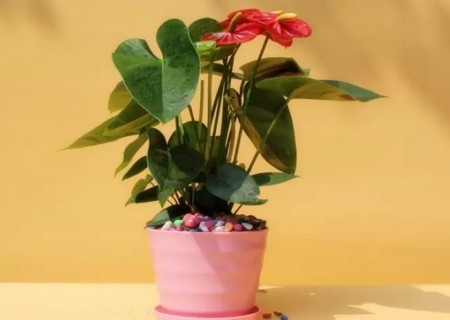
I. The best time for division
1. Best time: Anthurium division is mainly carried out in the cool, humid spring; it can also be done in cool autumn weather. Division is not suitable in hot summer or in dry, cold seasons. If greenhouse facilities are available, it can be done all year round.
2. Best leaf age: If the offset is too small, it grows slowly after division; if the offset is too large, it affects the growth of the mother plant. Generally, division can be carried out when the offset has grown 4-5 leaves, which is very beneficial to the growth of both the offset and the mother plant.
II. Preparation before division
1. Substrate preparation: Anthurium prefers a loose, well-aerated substrate. For division, a mix of peat and perlite at a ratio of 2:1 can be used, sprayed with carbendazim or thiophanate-methyl, stirred evenly, piled up sealed for 1 day, and then it is ready for use. At the same time, prepare soft plastic pots with a diameter of 9 cm or 12 cm, washed and disinfected.
2. Pot preparation: Different stages have different requirements for pot specifications. The small-seedling stage is generally completed at the propagation company, and the anthurium seedlings purchased for production are all medium seedlings (about 15 cm) or larger. Therefore, when potting them up, disposable red plastic pots of 160×150 mm can be chosen for planting.
3. Mother plant selection: Generally speaking, small and medium-sized anthurium varieties have stronger tillering ability than large varieties, produce more side shoots, and are suitable for division propagation. To ensure the mother plant has sufficient nutrients to grow and flower, the side shoots need to be removed and used for division propagation. The mother plant used for division must be robust and free of pests and diseases.
III. Operation and management
1. Separating offsets by hand: When transplanting the seedlings, use your hands to evenly and firmly pull the side shoots away from the mother plant at the underground stem bud eyes.
2. Separating offsets by knife: When separation is difficult, use a sharp, disinfected blade to cut it open at the bud eye. For cut-flower bud removal and division, first push aside the soil layer, pay attention to the distribution of the root system and the underground stem bud eyes, carefully cut open at the bud eye, and then take out the side shoot.
3. Disinfection of divided seedlings: The separated offsets are first graded by plant size, and after grading they are disinfected. First rinse their roots once with clean water, then soak them in a 100-fold solution of acyl peptide Wangensheng for 15-30 minutes, take them out, and dry the water on the roots.
4. Potting up divided seedlings: When potting up, combine two offsets of the same size into one pot; the root system must be spread flat and the plant upright, with support if necessary. Do not use too much substrate when potting up. After potting up, spray the divided seedlings with carbendazim to rinse the leaf surface and disinfect and sterilize; 1 day later, water the substrate thoroughly with purified water.
Precautions:
1. To avoid affecting the growth of other anthuriums in the greenhouse, a shade net can be set up above their benches to ensure weaker light.
2. The relative humidity should be relatively high, maintained at 75%-85%. If the humidity is too low, spray the leaf surface; especially when dividing in summer, pay more attention to increasing the frequency of leaf spraying.
3. Keep the temperature between 25°C-28°C; do not water the substrate too much, just keep it moist.
4. Generally, new roots grow after 20 days and the plants enter the normal growth stage. At this time, the light can be gradually increased and fertilized water can be applied, with unified management alongside tissue-cultured plantlets of the same size.
5. Because divided seedlings have relatively more pests and diseases, more attention should be paid to pest and disease control than with tissue-cultured plantlets.