Basic principles to follow when pruning fruit tree bonsai
When a fruit tree bonsai has too many branches, it easily leads to scattered tree nutrition, insufficient internal light, poor fruit quality, and so on. Therefore, before the fruit tree buds in spring, crossing branches, overlapping branches, diseased and pest-infested branches, and water sprouts should be cut off; this is called basic pruning. During the summer fruit growth period, pinching, bud removal, and heading back are used to control the tree shape and prevent the formation of apical dominance, so as to promote fruit growth and swelling. In autumn, in order to improve the ornamental effect of the fruit tree bonsai, shaping should be the main focus; branches that affect the ornamental effect can be cut off, and leaves covering the fruit can simply be removed.
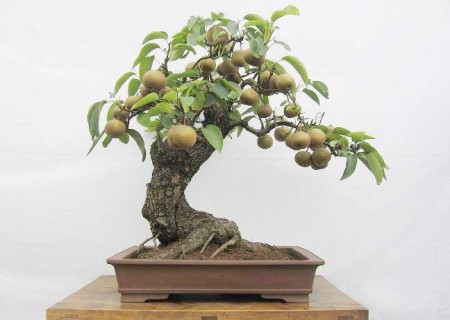
Carrying out physical pruning of fruit trees before they bud in spring can assist in dwarfing the fruit trees. When fruit trees grow too vigorously in the early growth stage, chemical agents such as B9, PP333, and chlormequat can be sprayed to inhibit their growth. It is best to prune when the flower buds are recognized, that is, when the flower buds first appear. Prune evenly at the flower buds, leaving the head and shape.
Fruit tree bonsai has the characteristics of combining shape and fruit and being dazzling; it has both an appearance for people to appreciate and fruit for people to eat. It uses shape to carry fruit and fruit to form shape, combining shape and fruit, and can be called an excellent product for home cultivation. To prune fruit tree bonsai scientifically and reasonably, certain rules must be followed and certain theories must be understood. Below are the ten principles of fruit tree bonsai pruning; please refer to them:
1. Two parts
That is, the aboveground part and the underground part, namely the canopy and the root system. These two parts are closely related. During the annual growth cycle of a fruit tree, these two parts are in a state of dynamic balance. To a certain extent, when the canopy is shaped and pruned, the more that is cut off, the stronger the vigor promoting canopy recovery. What is cut is the branches, but what it relies on is the roots; if the root system is damaged, it will inevitably affect canopy growth.
2. Two pathways
That is, the two pathways in the transport process of water and organic nutrients. Water and inorganic salts absorbed by the root system are transported upward to the canopy through the vessels of the xylem; organic nutrients produced by the leaves are transported downward to the root system through the sieve tubes of the phloem. The reasons that measures such as girdling improve fruit set, promote flower bud formation, and that "damaging the tendons and bones" (injuring the xylem) make the excessively vigorous parts of the tree weaker and slower are all because the normal functions of the two pathways are disrupted to achieve the intended purpose.
3. Two centers
For the aboveground part, the organic nutrients produced by the leaves during the fruit tree's growth period have two centers in the distribution process: one is transport to the most actively growing shoot tips for growth; the other is transport to the fruiting sites for fruit growth. If nutrients shift toward the growth center, the tree vigor will become excessively vigorous; if nutrients shift toward the fruiting center (excessive fruit set), the tree vigor will become excessively weak. One of the main tasks of pruning is to regulate the distribution center of organic nutrients so that growth and fruiting are coordinated and appropriate.
4. Two growth stages
The growth of new shoots in the annual cycle is generally divided into two stages: spring shoots and autumn shoots. Spring shoots, also called preformed shoots within the bud, play a decisive role in the early nutritional level of the fruit tree and belong to accumulating-type branches; autumn shoots grow out after the rainy season arrives, are unfavorable for fruit growth and flower bud differentiation, and belong to consuming-type branches. For young vigorous trees, autumn shoots can be fully used to achieve the purpose of light pruning and long retention to expand the canopy; for large fruiting trees, how to control and weaken the vigor of autumn shoots is one of the tasks of shaping and pruning.
4. Two techniques
That is, heading back and thinning out, which means cutting a branch short or removing it from the base. These are the two basic techniques in fruit tree pruning. Heading back is further divided into light, medium, heavy, and extremely heavy heading, all of which have a vigor-enhancing effect on the local part of the pruned branch. For the same branch, the heavier the heading, the stronger the local vigor-enhancing effect, and the smaller the growth amount of the headed branch. The lighter the heading, the weaker the local vigor-enhancing effect, and the greater the growth amount of the headed branch. Thinning has a vigor-reducing effect on the part above the cut, but a promoting effect on the part below the cut. Only when these two techniques are used in appropriate combination can the ideal pruning effect be achieved.
6. Combining winter and summer
That is, combining winter pruning with summer pruning. For young trees and trees beginning to bear fruit, relying only on one pruning in winter often leads to excessive pruning, too many shoots the following year, and late fruiting; if pruning lightly in winter and coordinating in summer with techniques such as wiping, pinching, peeling, twisting, pulling, and notching, canopy formation will be accelerated, and flowers and fruit will form earlier. The greater the amount of pruning after fruit trees bud, the more severely the tree's "vital energy" is damaged. Therefore, summer shaping and pruning should minimize leaf loss while achieving the purposes of controlling vigor, slowing vigor, early flowering, and early fruiting.
7. Lifelong contradiction
That is, the contradiction between growth and fruiting, which runs through the entire life cycle of the fruit tree and is manifested as tree vigor strength or weakness and the amount of fruiting. Determined by genetic laws, all measures for young trees that grow excessively and do not bear fruit achieve their purpose by weakening tree vigor.
8. Two driving forces
That is, light and water. Light is the energy source and determines the nutritional and accumulation level of the fruit tree; water is the lifeline and determines the growth vigor of the fruit tree. As the saying goes, "If the water pathway is well managed, the tree grows well; if the light pathway is well managed, the fruit sets well." This is the reasoning. In fruit tree shaping and pruning, the first things to consider are soil and fertilizer conditions and light and wind conditions. Only when the individual and population structure of the fruit tree matches the ecological conditions can the best effect be achieved.
9. Two dominances
That is, vertical dominance and apical dominance, namely the upward tendency and tip-oriented tendency shown in the growth process of fruit trees. This is the principle by which all fruit trees can grow tall and large. In the process of fruit tree shaping and pruning, adjusting the balanced relationship between growth and fruiting in the upper and lower parts and the outer and inner parts of the canopy is essentially adjusting the relationship between these two dominances.
10. Two angles
That is, the angle of the scaffold branches and the angle of the branch groups on the scaffold branches. Angle is the "key" to regulating the light pathway and water pathway, regulating the two dominances, and achieving coordinated growth and fruiting. From small to large angle, tree vigor changes from strong to stable and then weak; conversely, from large to small angle, tree vigor changes from weak to strong. The most effective measure for early fruiting of young trees is light pruning and long retention, with an open angle. Renewal of old trees relies on using the back branches and raising the angle.