How to manage pear trees after grafting to achieve a high yield
Pears are widely cultivated across both northern and southern China, with strong adaptability. They tolerate extensive management, bear fruit early and yield abundantly, and have a long economic life. The fruit stores and ships well, has good market appeal, and a long supply period, making it highly popular in domestic and international markets. Grafting is done to improve tree quality, enhance resistance, and promote high yields.
Master the ratio of yield to graft unions. Practice has shown that with multiple graft unions, trunk circumference, crown diameter and total branch number all increase noticeably, and the tree can basically maintain balance between its aboveground and belowground parts and the absorption and supply capacity of its root system, bringing the grafting survival rate to above 99%. The number of graft unions is determined by the tree's original yield; generally, for a large tree with an original yield of 200 kg or more, use one scion per 500 g of fruit; for trees under 200 kg, use one scion per 1000 g of fruit when top-grafting.
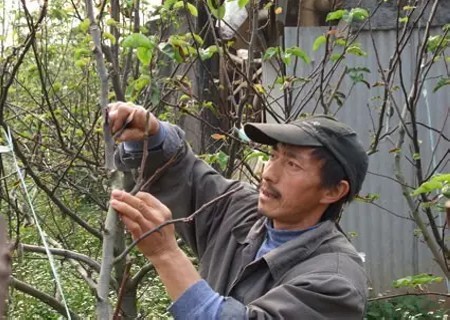
Use horizontal-branch grafting. Before top-grafting, first clean up the tree's branches, thinning out some large branches and overly dense branch groups according to the tree's shaping requirements. Cut back all the branches to be grafted according to their branching, smooth the cuts, and then graft; do not cut one and graft one, to avoid awkward movement or knocking off scions that have already been grafted. Use cleft grafting and cut grafting; depending on the thickness of the rootstock branch, use short scions with 2 to 3 buds or long scions with 3 to 5 buds. When grafting, change the traditional upright-branch grafting and choose horizontal branches as rootstock, inserting the prepared scions onto horizontal or drooping branches, to favor the accumulation of organic nutrients, and avoid inserting straight onto upward-growing branches as much as possible. Wrap the graft union with plastic film, and seal the top of the scion with wax to prevent water loss.
Do not pinch off the growing tips; untie the binding at the right time. That is, the new shoots that grow out after grafting in the same year must not be pinched off, as this helps the branches to terminate growth and easily form flower buds. Only twist the tips of vigorous or competing branches. In early July, untie the binding after the graft union has healed; for unions that have not yet healed, continue wrapping, and untie only after they have fully healed.
Set yield by the tree, set fruit by the flowers. For fruit trees grafted in the same year, during winter pruning focus on light pruning, allowing branches to grow and keeping more branches. At flowering time in the second year, according to tree age, crown size and the load on each branch, achieve "set yield by the tree, set fruit by the flowers."
Water is a limiting factor for high-quality, high-yield pear trees. If the water absorbed by the roots is not enough to supply leaf transpiration, then the water in the fruit is taken away by the leaves, causing the fruit to be small and lusterless, with little juice and a dry, mealy flesh that has gaps and well-developed stone cells. If water is insufficient and conditions are too dry in June, the calyx end will all harden, forming "iron pears." When water is severely insufficient in July, because some flesh cells develop poorly or even die, stone cells in the flesh increase markedly and the parenchyma cell membranes become suberized, making the fruit surface uneven and forming "lumpy" pears.
Pear trees are cross-pollinated species; most varieties are self-unfruitful, so pollinator varieties whose flowering periods basically overlap must be planted. The ratio of main variety to pollinator variety is best at 2:1 or 1:1, and at minimum 3:1 or 4:1, to achieve high and stable yields. The three-thinning technique means correctly mastering the timing and methods of thinning flower buds, thinning flower clusters and thinning fruit.