Key Points and Operation Methods of Chip Budding Grafting Technique for Pear Trees
Pear trees, due to the physiological characteristics of the variety or improper management, develop bare legs on the main branches (trunks), ultimately leading to a dense exterior and hollow interior, with fruiting branches becoming weak and shifting outward, ineffective consumption of nutrients, small fruit, poor quality, and low yield. To solve this problem, after several years of practical exploration, we adopted chip budding and hardwood branch supplementary grafting in spring, summer, and autumn, which effectively solved the problem and is simple and easy to carry out.
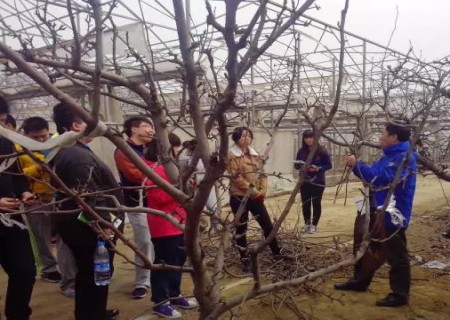
1. Before pear trees bud in spring
On both sides (slightly upward) of the bare-legged branches (trunks), graft 1 scion (of the same variety or another variety) alternately every 20 cm. Cut the scion to retain 2-3 buds, preferably a mix of leaf buds and axillary flower buds. Branches sprouting from leaf buds and axillary flower buds are not prone to excessive vegetative growth and easily form fruiting branch groups; if handled well, axillary flower buds can be grafted and bear fruit in the same year. The grafting methods used are hole-punching bark grafting or small-branch side cleft grafting.
2. In July
At the positions on the bare-legged trunk (branch) where fruiting branches are needed, carry out chip budding or bark grafting for supplementary grafting. Before sprouting the following spring, apply branching promoter to the surviving grafted buds or notch above the buds to promote sprouting and shoot growth.
3. From late September to early October
The grafting method is basically the same as in spring, except that axillary flower bud branches are preferably used as scions.
In spring, summer, and autumn, branches with axillary flower buds are used as scions; try not to use or minimize the use of water sprouts as scions, to prevent the newly grown branches from again forming bare-legged branches.
In addition, for hollow-canopied trees whose fruiting has shifted outward, use water sprouts on bare-legged branches to cultivate "dragon-turning-back" fruiting branches; that is, pull the water sprouts on bare-legged trees back in the reverse direction to the empty, branchless positions in the hollow canopy, and cultivate them year by year into fruiting branches. Ultimately achieve balanced tree vigor, balanced fruit set, stable and high yield, fruit with good coloration on the sunny side, and excellent quality.
For tree species whose branch tips have ridges or grooves, such as Chinese chestnut, jujube, etc., or when other plant materials are difficult to peel on both rootstock and scion, chip budding is used.
1. Taking the graft bud
Cut the buds on the scion from top to bottom. First, make a downward diagonal cut from 1.5-2 cm above the bud, slightly into the wood, then make a transverse diagonal cut 1 cm below the bud, and remove the bud plate.
2. Cutting the rootstock
At the selected height on the rootstock, choose a smooth spot on the shaded side, and cut downward a surface slightly into the wood, equal in length and width to the graft bud plate. Cut away the upper part of this opened bark that was slightly into the wood, and leave about 0.5 cm at the lower part.
3. Inserting the scion
Insert the bud plate into the cut so that the cambium layers of the two are aligned, then press the remaining part onto the bud plate, and tie it firmly with plastic strips.