How to prune a maple bonsai? The whole process explained with illustrations so you understand at a glance
The best viewing period for maples is when the new leaves have just unfurled. If all the leaves are removed in late summer and a thin, diluted application of decomposed liquid fertilizer is given, new leaves will grow in about 20 days, adding another best viewing period.
Maples have strong sprouting vigor and often produce new buds on the trunk. Any buds not needed for the design and any overly dense branches should be cut off promptly. This not only saves nutrients but also helps with ventilation and light penetration.
Pruning is generally done in mid-April.
A trident maple (Acer buergerianum) that has been grown in a pot for 20 years now has its new leaves fully grown, and it is now time to defoliate and repot it.
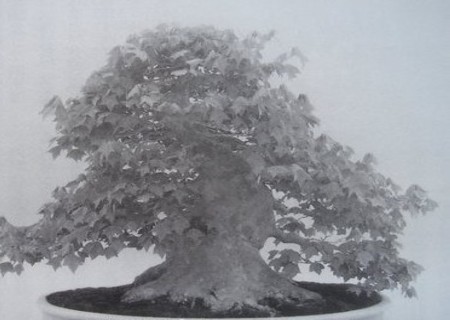
If the main skeletal branch on the left is left to grow freely, the small inner branches may die back.
The state after the leaves have been shaved off, but this is only a small part of the work.
Seen from above, A stands out too much, so there is no question of cutting it.
After cutting, the outline of the branch pad becomes neat and even.
The strong buds at the tips of the branches are cut off as well.
Even if weak, small leaves are kept, they will scorch once exposed to strong sun, so shave them off.
The stubs of remaining branches are also cut smooth and even.
A looks relatively thick and out of proportion; keeping it will only make it thicker, so cut it off flush to the base, smooth the cut, and apply wound sealant.
Branches with longer internodes are also shortened if there is no need to develop a pad on them.
Reverse-growing branches and downward-growing branches are also cut off.
Only with scientific and meticulous care year after year can a natural transition and well-balanced structure be achieved.
After defoliating and tidying the branches.
Generally speaking, the main purpose of mechanical defoliation is to speed up the development of small branches. However, once the branch pads have been developed to a certain degree, adjusting the balance of strength between the overall branch form and tree vigor through defoliation and branch tidying becomes crucial. Several defoliations and branch tidying sessions a year can effectively suppress the growth of strong branches and promote the strengthening of weak, small branches. While defoliating, removing buds from strong branches can effectively prevent leggy growth.
In addition, remove adventitious buds such as axillary buds, downward buds, and reverse-growing buds that affect the beauty of the branch form. After the leaves are shaved off is also the best time to observe the tree as a whole; branches that are out of proportion in length or thickness are dealt with on the spot.