Detailed Guide to Coleus Cutting Propagation and Seedling Cultivation Techniques
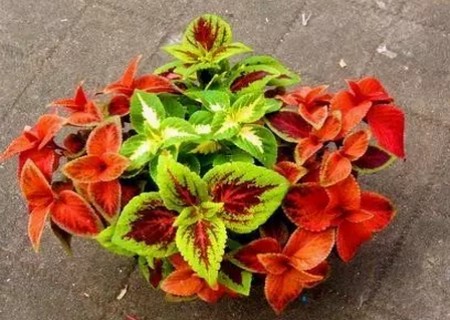
Coleus is an excellent potted foliage plant, and can also be used in flower beds in summer and autumn; its colors are vivid and very beautiful. At the same time, its branches and leaves can be cut for use as cut flowers, or as an ingredient in flower baskets, and it can also be planted in the same pot with spiderwort (Commelina), making it a great material for decorating the living room and study.
Coleus is commonly propagated by cuttings. For cuttings, in the growing season select not-too-old shoots with 2-3 nodes and insert them into loose soil or vermiculite; they will root in 1 week. When the seedlings grow to 2-4 true leaves, they need to be transplanted once. When transplanting, use a bamboo stick to lift the seedlings out with their roots and transplant them into a shallow pan, with a density such that the leaves do not touch each other; when the seedlings grow to 6-8 leaves, transplant them again into small pots with a diameter of 10 cm, and retain 2-4 leaves and pinch off the growing tips.
The potting soil can be a mix of 2 parts leaf mold, 1 part garden soil and 1 part sand. In July, when the seedlings are larger, repot them once more, and add a small amount of soybean cake as a base fertilizer at the bottom of the pot. During the growing period, pinch off the growing tips several times to promote branching and make the plant full and shapely, meeting ornamental requirements. For mother plants kept for seed, reduce the number of pinching times so that they complete flowering and seed setting before winter begins. For seed collection, select plants with vivid leaf color and isolate them to prevent hybridization and degeneration.
Key points of cutting technique:
1. Select stem nodes with terminal buds, 3-5 nodes, and a length of 5-10 cm as cuttings. After cutting the cuttings, trim some of the leaves to avoid excessive leaf area causing water loss from the shoots and cutting failure. Usually, all the leaves on the lower part of the shoot should be removed, and keeping a few leaves on the upper part is enough!
2. Coleus grows rapidly, so healthy shoots can be directly inserted singly as cuttings into flower pots with a diameter of 7.5 cm. After successful rooting, they can be maintained directly in the pot. If there is more space at home and the environment is suitable, they can be inserted into enlarged flower troughs.
3. Coleus roots very quickly; roots can grow about one week after cutting. Two weeks after cutting, apply dilute liquid fertilizer or slow-release fertilizer to let coleus enter the initial growth stage. After coleus grows normally, pinch off the growing tips once to promote branching and improve the ornamental value of the small potted plant.
Plug tray cutting seedling method:
1. Cuttings: Select tender shoots that are free of pests and diseases, moderately mature, and vigorous. At 1-0.5 cm above a leaf bud, make a cut sloping toward the bud, and use a sharp knife (or scissors) to cut a section of shoot about 5-7 cm long containing 2 or more axillary buds as the cutting.
2. Plug tray: A plug tray with a length of 54 cm, width of 28 cm, height of 5 cm, cell diameter of 3 cm or 2 cm, and depth of 5 cm can be selected.
3. Substrate: Choose a loose and breathable substrate, such as peat and perlite (3:1), leaf mold and sawdust (1:1), or peat and garden soil (1:1).
4. Cutting: In a greenhouse, plug tray cuttings can be done from March to October, and outdoors mostly from April to September. The cutting density should be such that the leaves do not cover each other and do not affect photosynthesis, and the cutting depth should be 2 cm; it should not be too deep, so as not to affect rooting. After inserting, place the plug tray under a shade net with a shading rate of 70%, at a temperature of 25°C-32°C, in a small environment with a gentle breeze.
5. Watering: After cutting, determine the watering time and frequency according to weather conditions. On sunny days, spray water on the substrate surface every 2 hours; on cloudy or rainy days, spray less or not at all, keeping the air humidity at around 90%, and note that the substrate must not become waterlogged. About 10 days after cutting, new roots grow; gradually reduce the frequency of misting, and after half a month, transplant or plant out and enter normal management.