Illustrated Tutorial on New Techniques for Plant Cutting Propagation
Plant cutting propagation is one of the excellent methods for cultivating superior seedlings. Cutting propagation makes use of the regenerative capacity of plant roots, stems, leaves, and buds, enabling them to take root and sprout under suitable conditions to form new plants. It has the characteristics of fast propagation speed, easy collection, minimal genetic variation, and convenient management.
The weather is getting hotter day by day. Every year in early summer is a great season for many flower enthusiasts to busy themselves at home propagating their beloved plants. Cutting is a method of flower propagation, which involves cutting a portion of plant tissue and using certain techniques to breed new plants. It is also the simplest method of plant propagation most suitable for flower enthusiasts to carry out at home. Below is an introduction to new techniques for plant cutting propagation (illustrated):
1. Selecting Suitable Cuttings
The branches used for cutting propagation are called cuttings. After cuttings are inserted, they first form root primordia, and then new roots grow from the root primordia. Cuttings should be cut from healthy mother plants free of pests and diseases. The more vigorously the mother plant grows, the faster the cuttings will root. Usually, new branches root more easily than aged branches, and growing branches root more easily than dormant branches. Therefore, when cutting cuttings, choose branches that have developed for some time, are medium-mature, plump, and full, and are between green tender branches and brown lignified old branches.
2. Cutting the Lower End of the Cutting at an Angle
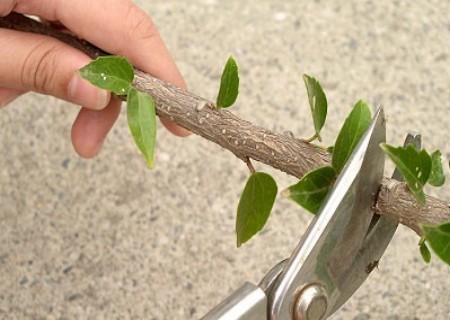
Use sharp pruning shears or a blade to cut the cuttings. The cut should be smooth and clean, preferably done in one cut, clean and neat, to facilitate rooting. If the cut is damaged, it is prone to rot when inserted into the soil. When cutting, take 2-3 nodes as one section, with a length of about 10-15 cm. To avoid upside-down insertion that prevents rooting, pay attention to the position of axillary buds and leaf scars when cutting. You can also cut the upper end of the cutting flat and the lower end at an angle as a way to identify orientation.
3. Trimming Excess Leaves
To prevent cuttings from rapidly dehydrating and wilting, the lower leaves of the cutting must be completely removed. The upper leaves can also be completely removed, or 3-4 leaves can be retained. If the leaves are too large, cut them in half. Flower buds and flower buds should also be removed. The sooner cuttings are inserted after cutting, the higher the survival rate. If not inserting immediately, wrap them in a moist cloth, paper napkin, or sphagnum moss, or place them in a plastic bag with a few drops of water to maintain moisture. However, for succulent plants such as cacti, frangipani, and desert rose, because the plant body contains a large amount of sap, after cutting the cuttings, you should instead wait until the cut surface has completely calloused over before inserting, to prevent basal rot.
4. Applying Rooting Hormone
Before inserting, apply rooting hormone to the cut end of the cutting, such as rooting powder, which can effectively promote rooting and improve the survival rate of cuttings. Commercially available rooting hormones come in two forms: liquid and powder. Liquid is commonly used for soaking large quantities of cuttings, while powder is more convenient for small quantities. Plants that root easily from cuttings, such as datura, lantana, and ruellia, can grow smoothly even without applying rooting hormone.
5. Poking Holes with a Tool
After leveling the soil surface, to avoid injuring the buds on the branches from friction with the soil and to prevent the rooting hormone on the cut end from touching the soil and falling off, use a finger, pen shaft, bamboo stick, or other tool similar in thickness to the cutting to poke holes in the soil surface. Never insert the cutting directly into the soil. The medium material must have good drainage and aeration and be easy to keep moist. Coarse sand, vermiculite, perlite, peat moss, and fine fern fiber are all very suitable.
6. Paying Attention to Insertion Depth
Insert the cutting into the hole, press firmly with your hand to secure it, so that the base of the cutting is in close contact with the medium, then water thoroughly. The insertion depth should be about two-fifths of the cutting length. Too deep can cause water accumulation and rot at the base of the cutting, while too shallow can cause rapid wilting due to water evaporation. Usually, herbaceous flower cuttings can root in about 1-2 weeks, foliage plants and softwood cuttings of woody plants take about 3-4 weeks, and hardwood cuttings of general plants take about one month to root.
7. Management After Cutting
The ideal temperature for cuttings is about 20-25°C, with soft light (about 40-60%). After insertion, place them in a shaded, bright, and ventilated environment. To reduce rapid water evaporation, absolutely avoid direct strong sunlight. Use gauze netting, shade netting, etc. for shading, but excessive shading prevents photosynthesis, and even if roots form, it is very difficult for them to survive. Before cuttings root, maintain very high air humidity (about 70-80%), and spray frequently to keep moist. However, for succulent plant cuttings, instead maintain a semi-dry state to prevent the cuttings from rotting. During low temperatures in winter or cold spells, avoid watering in the evening or at night, to prevent water from stagnating overnight on the cuttings or in the soil, causing cold damage or frost injury.
8. Covering with a Transparent Plastic Bag to Retain Moisture
For plants that are more difficult to root, you can use transparent glass, plastic sheeting, or plastic bags to cover and seal the cutting bed or cultivation pot, preventing water evaporation and maintaining high air humidity, which has a significant effect on improving the survival rate. The plastic bag should be removed after about 7-10 days; covering for too long can easily cause the cuttings to mold due to stuffy, humid air. Once the cuttings sprout new buds, grow normally, and vigorous root development is observed through the bottom drainage holes, they should be transplanted in a timely manner.
The management of potted plants after cutting mainly involves watering and shading, to prevent excessive water loss through evaporation that affects survival. Since the cuttings have no roots but have a small amount of leaves above ground, the cuttings only lose water through evaporation without absorption function, causing an imbalance of water within the cutting body. They need to wait until they root before they can absorb water. Therefore, in cutting management, it is necessary to keep the soil moist, pay attention to shading, ventilate and let light through in the morning, water after rooting, and gradually increase sunlight exposure time. Weeding and pest removal should be carried out at any time. After rooting and growing new leaves, apply a compound fertilizer once. Once the plants are sturdy, they can be transplanted.
Regardless of which cutting method is used, after insertion, be sure to water thoroughly, then cover the cutting pot with glass or plastic film to maintain a certain temperature and relatively high humidity. Place in a semi-shaded area, strengthen management, and after rooting, proceed with transplanting and cultivation. To achieve a high survival rate for cuttings, in addition to selecting good cuttings, the substrate is also very important. The substrate must have good drainage and also a certain water-holding capacity. Vermiculite, perlite, furnace slag, and rice husk ash are good cutting substrates. The substrate should be maintained at a temperature above 20°C, meaning the atmospheric temperature should be above 25°C, so that the cut end of the cutting can heal easily and root.