How to prune a Malus halliana bonsai? Detailed methods and techniques
In a poem by Yang Wanli of the Song Dynasty: “The weeping crabapple has a charm all its own, who says it loses entirely to the Sichuan crabapple. The wind stirs the Jade Emperor's red world, the sun warms the Green Emperor's purple robes. Lazy and strengthless, still drunk with spring, waking with spirit, ready for dawn makeup. Present this to an old man as a new verse, and see whether peach or apricot dares to match it.” It describes the gorgeously alluring weeping crabapple, whose bright red petals churn the blue sky and the heavenly realm red, with purple-tinged calyxes glinting like purple robes, and soft drooping red flowers like a young woman who has drunk wine, her jade skin flushed red, delicate and weak. Its beauty and alluring manner surpass even peach, plum and apricot.
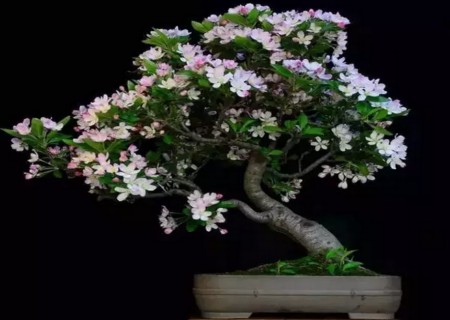
The weeping crabapple (Malus halliana) has brilliant flowers and graceful flower forms; its slender pedicels droop in bends one after another, swaying to and fro at the slightest breeze, hence the name weeping crabapple. The flowers cluster at the tips, the petals are rose red, each bloom bending and drooping, swaying to and fro at the slightest breeze, delicate and red. Seen from afar it is like dense red clouds, a beauty beyond description, and it is a favorite flower for balconies and courtyards.
Let us now look at how to prune the weeping crabapple!
1. Early spring pruning
Before early spring sprouting, promptly prune diseased and pest-infested branches, dead branches and overly dense branches; for old plants, renew old branches, specifically: saw off the upper end of large branches with few twigs, and after new shoots sprout, cut away the thin weak branches.
2. Flower-promoting pruning
The weeping crabapple has vivid flower colors and dense blooms, making it an excellent flowering tree species. To make the weeping crabapple bloom densely and extend the viewing period, the method of successive pruning rounds can be used:
After one intensive pruning of the weeping crabapple in winter, it begins to sprout in late April the following year, and by mid-May the new shoots can grow to about 20 cm. At this time, the new shoots need one pinching treatment, keeping about 15 cm at the lower part, to encourage branching at the tips and prepare for successive rounds of flowering. All other unused small branches should be removed entirely.
In mid-June, the two small forks produced by the first pruning have grown to 30-40 cm long and have also produced flower clusters; prune one of the two forks, cutting away the flower cluster, to encourage its axillary buds to grow and branch, serving as the second-round flowering branch.
1) The first-round flowers open around early July; after flowering, cut away the spent flowers to encourage sprouting and growth, and sprout third-round flowering branches.
2) The second-round flowers open in early August; after flowering, cut away the spent flowers to encourage sprouting of fourth-round flowering branches.
3) The third-round flowers open in mid-August; after flowering, the spent flowers must also be cut away to ensure sufficient nutrients for the fourth round of flowering.
4) The fourth-round flowers begin in late September and can continue all the way to November.
In this way, the flowering period of the weeping crabapple can be extended considerably. Then carry out one more heavy pruning in winter to ensure flowering the following year.
3. Post-bloom pruning
Prune after flowering; according to the tree shape required, shorten overly long branches to encourage side branches and increase the formation of flower buds. In addition, shaping and pruning can also be done during the dormant period, mainly to cut away branches that affect the appearance.
4. Shaping and pruning:
Under natural growth, the weeping crabapple has spreading branches and an open crown, very suitable for pruning into an open, tiered form, with the shaping zone ranging from 80-120 cm, 3-4 branches per tier, developing in tiers, with the main branches gradually decreasing from bottom to top.
After the grafted seedling survives, cultivate the central trunk first for 1-2 years; when it reaches above the height of the shaping zone, leave the trunk 1-1.3 m high and cut off the tip of the seedling, train the new shoot sprouting from the cut bud into the central trunk extension branch, and below it successively select and keep 3-4 new shoots sprouting from axillary buds to train as the first tier of framework branches.
In the second year, on the central trunk extension branch use the same method to train 2-3 secondary main branches as the second tier of framework branches, and cut off part of the central trunk; if by then the central trunk has already deviated from the axis, it may also be left uncut, using the leaning central trunk as one of the secondary main branches, while at the same time selecting and keeping a small number of side branches on the main branches.
In the third year, on the secondary main branches again select and keep 1-2 side branches as framework branches. Each main branch is required to have a certain distance from the others on the central trunk, distributed openly on the central trunk, and they must not overlap one another. Normally, when there is no special conflict among the large branches, do not readily remove large branches.
After the framework of the weeping crabapple plant is basically formed, the main task is to cultivate secondary side branches and the branches that grow from them to form large flowering branch groups and bloom abundantly. At the beginning such branches are few in number and there is ample space, so generally it is not suitable to shorten them, but rather to leave them to grow freely and let them grow naturally.
In the second year, 2-3 long shoots can sprout at their tips, and medium and short shoots generally form in the middle. As the branches growing from the secondary side branches increase, appropriate pruning is then needed to encourage the latent buds at their base to gradually sprout into branches, thereby preventing the rear part from becoming bare.
The specific method is:
Cut away the tip of the secondary side branch together with 1-2 long shoots, and shorten the long shoot below the cut, so that it continues to form long shoots and expand the crown.
For the overly long medium and short flowering branches at the rear part of this branch, the tips can be appropriately cut back. Generally they can be left to send out flowering branches and bloom. Thereafter, each year treat the long shoots at the tip and the medium and short shoots at the rear in this way, so that the small side-branch groups or the larger flowering branch groups are alternately retracted and renewed each year, and generally can be maintained within a certain range without expanding too quickly.
A few years later, when this branch group ages, a vigorous growing branch can be selected from the base or nearby as a renewal branch to take its place, gradually retracting the old branch group.