Detailed Explanation of Crabapple Bonsai Styling Methods and Techniques
The crabapple has graceful flowers, with brilliant blooms in spring and abundant red fruit in autumn, dainty and lovely. It not only provides beautiful flowering and fruit-bearing tree species for park landscaping, but is also an ideal bonsai material. However, crabapple bonsai tree shapes are mostly made into slanting-trunk style, curved-trunk style, or cascade style. Emphasis should be placed on expressing the vigorous yet supple character of its branches. An old stump bonsai with slanting, horizontal branches and brilliant blossoms is the most full of charm.
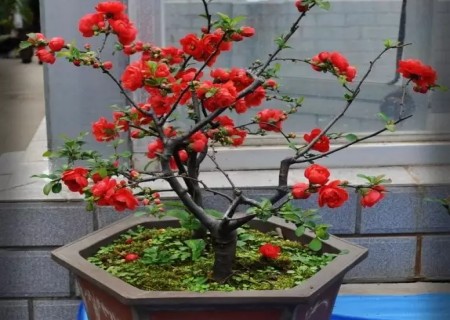
The crabapple has strong sprouting ability and grows quickly, requiring careful beautification and pruning. It can be processed into many styles such as slanting-trunk style, curved-trunk style, waterside style, cascade style, double-trunk style, and multi-trunk style. Styling is best carried out after flowering or during the dormant period. From leaf fall in summer to bud break in spring, disordered branches such as dead branches, diseased and pest-infested branches, weak branches, crossing branches, stacked branches, and overly dense branches can be cut away. After flowering in spring, overly long branches can be appropriately shortened according to the desired shape, promoting the growth of lateral branches and increasing the number of flower buds.
Crabapple styling and processing often combines wiring with pruning, and the processing period is best from after leaf fall in winter to before budding in spring. Crabapple bonsai can be shaped by wiring with metal wire. Because the crabapple grows relatively quickly, care should be taken to remove the palm fiber or metal wire in time to prevent "wire bite," thereby avoiding harm to the tree.
In addition to styling needs, pruning branches and leaves in early spring can also ensure the plant blooms abundantly. Branch and leaf pruning should be carried out from after leaf fall to early spring budding. Weak branches, diseased and pest-infested branches and leaves, individual overly long branches and leaves, and overly dense branches and leaves can be removed. Sparse areas of branches can also be pruned downward to encourage more lateral branches.
Crabapple styling and processing often combines wiring with pruning, and the processing period is best from after leaf fall in winter to before budding in spring. During the plum rain period, new branches have already grown relatively mature and the branches are more elastic, so it is also suitable for pruning and wiring. Seedlings 2-3 years old can begin processing; at this time they are highly malleable and easier to work with. It is best to use both palm fiber and metal wire. The trunk and large branches need appropriate wiring, while all small branches are shaped entirely by pruning. It is best to prune the branches and leaves into a natural crown; wiring them too regularly is not advisable.
Flowers bloom and fall, flowers fade and fly away; as plum blossoms wither, the crabapple is reborn. The crabapple was Premier Zhou Enlai's favorite flower, with elegant blooms like brocade. The crabapple blooms brightly and beautifully. Let our love of beauty continue to be passed on in this warm season of crabapple blossoms!