How to grow pennywort in water? Detailed steps you'll get at a glance
Pennywort (Hydrocotyle vulgaris) is a creeping, emergent aquatic herbaceous plant, with round kidney-shaped leaves and glossy emerald-green leaf surfaces. Growing pennywort with the water culture method is relatively a lazy gardener's favorite approach. In recent years, water culture has become all the rage, and among water-cultured plants, pennywort can be said to stand out above the rest. Because of its simple and down-to-earth nature, it has become a household decorative plant much loved by many flower enthusiasts and even ordinary people.
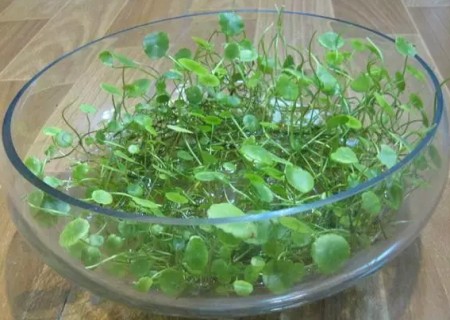
Have you ever thought about growing a few pots of pennywort in the office or at home? It can not only be used as medicine, but also green up the environment. When you are tired from work, it is also very nice to rest your eyes on it! So, do you know how to plant pennywort and how to care for it normally? Today the editor will introduce this water-cultured plant that is popular among the public.
Key points of pennywort water culture technique:
1. Pennywort is suitable for rough, extensive care; as long as it gets enough sunlight and water, it can grow very fast.
2. If indoors, with no sunlight, you can use lamplight instead.
3. The water needs to be tap water that has been left to settle for two hours, or used the next day.
4. You can add a little nutrient solution to the water.
5. Pennywort generally has some yellow leaves, but the speed at which they wither is far slower than the speed of growth, so do not worry.
6. Green algae will grow on pennywort's root system, but it does not need to be washed off.
7. As long as the water has not become foul and smelly, you just need to top it up, and at the same time mist the leaf surface with a little water regularly.
Suitable time for water culture: spring, summer
Pennywort water culture steps:
1. Cut several sections of stolon, each section with at least 3 nodes, and properly trim off excess leaves. After rinsing clean with water, put them into a container. Pay attention to the placement so that the stolons are soaked in water as much as possible (it is best to use tap water that has been left standing for more than 2 days).
2. Before new roots grow, place the container in a bright environment as much as possible, be careful not to expose it to direct sunlight, and clean up rotting stems and leaves at any time.
3. During water culture, you can properly add some nutrient solution to the water to maintain what the plant needs during its growth period. For friends with high aesthetic demands, you can put in some crystal balls, ceramic granules or pebbles, but not too densely, so as to give the roots normal growing space.
4. After about a week, new roots begin to grow, and afterwards you can increase the light and carry out normal management.
5. If leaves turn yellow, pay attention to using nutrient solution or spraying the leaves several times a week with a compound fertilizer mainly based on nitrogen fertilizer. When water moss appears on the roots and leaves, change the water immediately and clean the container, otherwise it is harmful to the plant and also affects its ornamental value. Usually pay attention to whether the water in the container is sufficient, to avoid it drying up.
6. Pennywort has a strong phototropic tendency, so pay attention to changing the orientation of the container, otherwise the leaves easily grow leaning to one side, affecting the appearance.
7. Pennywort grows fast; when the plant is relatively dense, it can be transplanted into a larger container, or you can continue growing it in the original container, but be careful to provide sufficient nutrients.
8. If old leaves turn yellow, cut them off in time; when it grows to a certain extent, flower stalks will emerge, and a portion of them can be cut off.
9. Pennywort is afraid of cold. In winter, for pennywort placed outdoors, you can pour out all the water and place it in a south-facing, sunny, wind-sheltered spot, and it can winter safely, only some leaves will wither and die, and the underground roots will sprout again the following spring. In cold northern regions without heating, you can make a cover and cover it together with the pot, pour out the water, keep it moist, and as long as the room temperature is not below zero, it will likewise continue to grow next year.