How to grow ginkgo seedlings by grafting softwood twigs? Detailed technical points
Ginkgo is a very ancient tree species, with a history of several hundred million years. Ginkgo has extremely high landscape value as well as economic and medicinal value. Ginkgo is currently planted very widely, and the market supply of ginkgo saplings every year is astonishing. So how is ginkgo propagated artificially? This article introduces one method commonly used in ginkgo seedling propagation technology——softwood grafting technology.
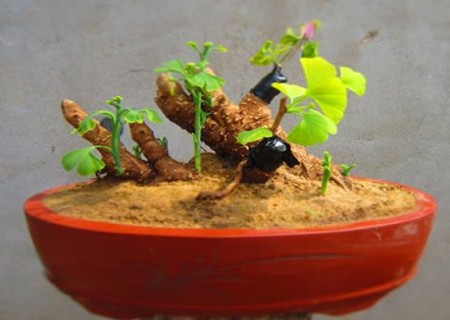
Ginkgo grafting is generally carried out between June and September, but grafting in August gives the best results, because at this time the softwood twigs are thick and full, the nutrients contained in the twigs are also rich, the graft union heals quickly, and the survival rate is relatively high. Grafting should be done on cloudy days and during low temperatures on sunny days. Grafting is not suitable in rainy weather or at noon during high-temperature weather, otherwise survival will be affected.
I. Preparation before grafting
1. Selection of scions
New shoots with plump buds should be cut from the middle and upper parts of the outer canopy of superior mother trees and used as scion wood. Remove the leaves from the scion wood, tie it into small bundles, and wrap the base with a damp cloth to keep it moist.
Scions should preferably be collected from a superior-variety scion orchard or from excellent mother trees. New shoots with plump buds should be cut from the middle and upper parts of the outer canopy of the mother tree and used as scion wood. Cut the leaves from the scion wood, keep the petioles, align the bases, tie into small bundles, and keep the base moist with a damp cloth. Scions should be grafted as soon as possible after collection; those that cannot all be grafted the same day should be placed in a refrigerator or a cool, ventilated place and stored moist.
2. Selection of rootstock
Requirements for grafting rootstock: 2- to 3-year-old seedling rootstock or cutting-propagated rootstock that is robust in growth, straight in trunk, strong in stress resistance, and suitable in height.
2- to 3-year-old seedling rootstock, cutting-propagated rootstock, and root-sucker rootstock can be used as rootstock. The selected rootstock is required to be robust in growth, straight in trunk, strong in stress resistance, and suitable in height. The height of the rootstock seedling varies according to the cultivation goal: for early fruiting and close planting, the grafting position is about 1.0 m, and the seedling height is required to be about 1.5 m; for courtyard planting, the grafting position is 1.5—2.0 m, and the seedling height is required to be 2.0-2.5 m; for road greening, the grafting position is about 2.5 m, and the seedling height is required to be about 3 m.
II. Grafting time
June to September are all acceptable, but grafting in August gives the best results; at this time the softwood twigs are thick and full, the nutrients they contain are rich, the graft union heals quickly, and the survival rate is relatively high. Grafting should be done on cloudy days and during low temperatures on sunny days. Grafting is not suitable in rainy weather or at noon during high-temperature weather, otherwise survival will be affected.
III. Operation method for ginkgo softwood grafting
1. Cutting the scion: cut a section with 2-3 buds from the scion wood as the scion, cut a wedge-shaped cut 2-3 cm long on each side of the lower end bud, and cut flat at 0.5 cm above the upper end bud of the scion.
2. Cutting the rootstock: cut off and smooth the rootstock at the grafting position, and make a vertical split in the middle of the cut surface, with a depth equal to the length of the scion cut surface.
3. Inserting and tying: insert the cut surface of the scion into the split of the rootstock, align at least one side of the cambium of the two, and then tie the graft union well with plastic film tape.
IV. Care and management after grafting:
Check for survival half a month after grafting. The method for judging survival is: touch the petiole; if it falls off immediately, it means it has survived; otherwise, it has not survived. After the graft union has completely healed, remove the tying tape. At ordinary times, pay attention to frequently removing sprouts from the rootstock, strengthen fertilizer and water management, and promptly prevent and control pests and diseases, so as to promote the growth of the grafted plants.
Because the softwood twigs are not yet fully lignified, a relatively thin plastic film tape should be used for tying during grafting, and tying should be only firm enough, not too tight, so as not to damage the scion and affect survival. Softwood grafting can also be applied to top grafting for variety replacement, and for softwood twigs with a relatively high degree of lignification, the bark grafting method can also be used.
Grafting propagation is the main propagation method in ginkgo cultivation. It can advance fruiting and make plants dwarfed, full, and high-yielding. Generally, grafting is carried out in spring from mid-March to early April using methods such as side grafting, bark grafting, or cut grafting. Scions are mostly selected from 20- to 30-year-old plants with strong growth and vigorous fruiting. Generally, branches 3 to 4 years old with about 4 short shoots are selected as scions, and generally 3 to 5 scions are grafted per plant. Fruiting begins 5 to 8 years after grafting.