Detailed Explanation of Grafting Techniques and Methods for Ginkgo Bonsai
Ginkgo is a long-lived tree; it not only grows slowly but also flowers and sets seed very late. Seedling ginkgo trees generally need 20 to 30 years of growth before they can flower and bear fruit, and the yield is low with poor quality. However, if grafting cultivation techniques are used, 2—3 years can flower and set seed. And using grafting propagation can not only bear fruit earlier, but also maintain the excellent traits of the mother plant and dwarf the tree shape. Therefore, ginkgo cultivation mostly uses the grafting method, but how to improve the grafting survival rate? Through practice and investigation, it is believed that the following main technical measures should be mastered:
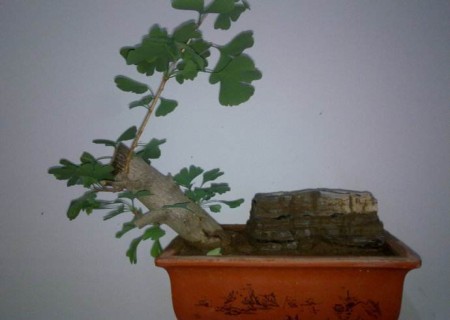
I. Control environmental factors well
1. Temperature at grafting time
Generally, the temperature for callus tissue formation is 18-25°C. Too high or too low a temperature will affect the formation of callus tissue. On sunny days, the temperature is high, air humidity is low, light is strong, evaporation is large, and grafting survival is low; on cloudy days, the temperature is relatively low, air humidity is high, light is weaker, evaporation is small, which is conducive to grafting survival.
2. Humidity at grafting time
Humidity also has a great influence on the formation of callus tissue. If humidity is too low, evaporation is intense, the water content at the grafting site decreases, cambium cells grow slowly or even stop activity, causing the plant to die. But if there is too much water and humidity is too high, it is easy to cause wound rot and affect survival.
3. Light at grafting time
Under dark conditions, the callus tissue growing from the cut surface is mostly milky white and very tender, and the rootstock and scion are easy to heal; while under light conditions, the callus tissue is sparse and hard, light green and not easy to heal, and only relies on the light-blocking part within the graft union to form callus tissue, which affects the chance and speed of survival. Therefore, when grafting, it is necessary to understand the weather conditions and pay attention to avoiding adverse weather conditions. For example, cloudy and damp low temperatures, windy days, and rainy and snowy days are all unsuitable for grafting. Cloudy days, windless and relatively humid weather are most suitable for grafting.
II. Select rootstock and scion well
1. Selection of rootstock
3-4 year old thick, plump, well-developed root system, fresh bark color; 2—3 year old seedlings are preferred, because 2-year-old seedlings have many branches and leaves, and seedling trees with well-developed root systems are used as rootstock. The thickness of the rootstock and scion should not differ too much. Their nutrient storage is abundant, so the grafting survival rate is high, generally above 90%.
2. Selection of scion
Select 1-4 year old branches that are well developed and have plump buds as scions. The length is generally based on retaining 3 buds. The upper cut of the scion should be flat. It is best to use them as soon as they are collected and not to leave them for too long. After the scions are cut, they must be wax-sealed immediately to prevent water loss.
During the growing season, collect 1-year-old branches from 30—40 year old superior variety trees as scions. Use them as soon as possible after collection. If long-distance transport is needed, pay attention to moisture retention to prevent rot. If conditions permit, store at low temperature (3—5°C), or seal with wax to retain moisture. Ginkgo is dioecious, so when collecting scions, they should be collected and stored separately according to different sexes.
III. Make good use of grafting techniques
1. Grafting methods
Before both the rootstock and scion have separated bark, use the cleft grafting or cut grafting method; when the rootstock has separated bark but the scion has not, use the bark insertion grafting method. When both the rootstock and scion have separated bark, use the bark insertion and tongue grafting method; during the growing season, the bud grafting method can be used.
Grafting is carried out from late June to early August each year. When grafting, cut off the rootstock at the semi-lignified part of the new shoot, and use a sharp knife to make a vertical cut in the center of the cut, with a length of 2—3 cm. At 1 cm below the scion bud, cut downward into a wedge shape with symmetrical sides and a slanted cut surface 2—3 cm long, then cut off at 1 cm above the bud to form a single-bud, bilaterally symmetrical wedge-shaped scion. Quickly insert the prepared scion into the rootstock cut, align the cambium on the smallest side of both, and promptly tie it tightly and firmly with plastic strips, exposing the bud eye.
If conditions permit, a plastic bag (diameter 3—4 cm, length 10—15 cm) can be placed over the scion to prevent excessive water evaporation and provide protection. The grafting time should preferably be chosen on cloudy days with low temperature and high relative humidity, but grafting cannot be done on rainy days. After the graft survives, the plastic bag should be removed promptly. In addition, female and male grafted seedlings in the nursery should be distinguished.
2. Grafting period
Grafting can be carried out in all four seasons. Practice has proved that spring grafting is the best time, because at this time the weather is gradually warming, sap begins to flow from bottom to top, cambium activity is active, and survival after grafting is easy. Generally, the grafting survival rate is relatively high from 10 days before "Qingming" to 5 days after "Qingming".
3. Grafting speed
Place the prepared scion with the long cut facing inward and the short cut facing outward, quickly insert it into the rootstock, and the cambium of both must fully match. Then place the outer bark peeled open on the rootstock directly against the outer cut of the scion, hold it upright and pinch it tight. Then tie it tightly and firmly with plastic film strips. According to the thickness of each rootstock, 1-3 scions can be grafted. To prevent rain and transpiration and help survival, bags can be tied over the scions.
IV. Pay attention to post-grafting management
After grafting, remove sprouts promptly and control pests and diseases. After branches sprout, set up supports. When the soil is dry, water promptly to ensure normal water supply. In addition to applying sufficient base fertilizer, when topdressing, also use thin fertilizer frequently (for example, liquid compound fertilizer can be sprayed once about every 10 days, to the extent that the leaf surface is moistened). Loosening the soil and weeding should also keep up.
After the graft survives, it can grow in the original seedbed for 1 year. During this period, heavy fertilizer and heavy water should be applied, foliar fertilization can be carried out, and timely cultivating and weeding should be done to speed up seedling growth. In the spring of the 2nd year after grafting, transplant and plant at a spacing of 30 cm×60 cm. After another 2 years, thinning can be carried out by alternate rows and alternate plants to help cultivate large seedlings of different specifications. Seedling transplanting can be carried out around Frost's Descent.