Detailed Explanation of Key Points on Marigold (Tagetes patula) Propagation and Seedling Techniques
In a previous article, we mentioned that marigold (Tagetes patula) is suitable for planting at the edges of flowerbeds or in gardens, and can also be used for potted plants and cut flower material. Marigold was formerly also called “sun flower,” but later that name was taken by the sunflower. Marigold is a sun-loving plant, but even without light it can still bloom normally. As long as there are suitable temperature and humidity conditions, it can grow freely, making it a flowering plant with very strong adaptability. Today we will introduce the sowing and seedling techniques for marigold.
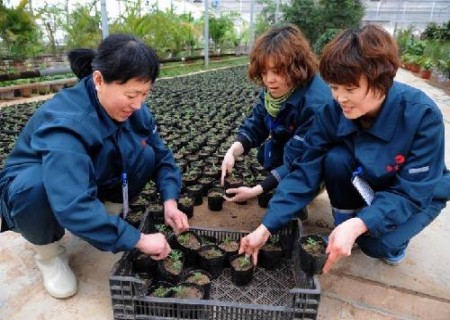
Because marigold has a very strong ability to adapt to its environment, in the south it can be sown all year round, while in the north, due to the excessively cold weather, it is recommended to sow in spring. If sowing in large quantities, plug tray seedling raising can be used for propagation. To complete the sowing and seedling work, this process needs to go through four stages:
1. After sowing, the embryo will show white in 2-5 days. Marigold seeds do not need light conditions to germinate; after sowing, simply cover them with a thin layer of straw, which not only shades the seeds but also helps retain moisture for them. The potting soil only needs to be slightly moist; avoid soil that is too wet. Under normal temperatures of around 20 degrees, they can germinate normally.
2. After one week, the seeds can complete the process from showing white to fully unfolding their leaves. When the radicle appears, attention should be paid to taking cooling measures, and watering should only be done after the soil has slightly dried. Appropriately increasing light and applying a small amount of fertilizer is more conducive to the plant rooting and sprouting.
3. During the rapid growth period of the seedlings, avoid excessively high humidity, but also ensure the water supply for the young seedlings, so when watering, this balance must be well controlled. Do not let the potting soil become too dry, which would inhibit seedling growth or even cause the seedlings to wither; cooling treatment can be applied to them. In addition, apply fertilizer alternately every other week, but ammonium nitrogen fertilizer must not be used when the temperature is below 18 degrees Celsius. After taking these measures, the plant's root system will grow to 3-5 cm, and the seedling height will also reach 3-4 cm with 2-3 pairs of true leaves appearing.
4. The fourth stage belongs to the hardening-off period. At this time, the plant's root system has basically formed, and at least 3 pairs of true leaves will appear. At this point, the temperature can continue to be lowered to 15 degrees Celsius, but ammonium nitrogen fertilizer still must not be used. As in the second stage, during the second watering, let the soil dry out completely, while strengthening ventilation to prevent the plant from becoming leggy.
However, practice has shown that some gardening friends may experience seedling failure, so we need to investigate the causes of the failure. If seedling failure occurs or other problems arise, we mainly check from the following aspects:
1. The pH value of the soil
If the soil's pH value is too low, it will cause necrotic spots, scorched edges, and necrosis of growth points on old leaves; if the pH value is lower than 6, it may also cause excessive trace elements. The treatment measure is to adjust the pH value so that it is between 6-6.7, which can be regulated by adding lime water.
2. Improper seedling temperature
When raising seedlings in a low-temperature environment in early spring, the temperature should be appropriately increased and humidity controlled to prevent disease infestation. But if the temperature is too high, it will also cause harm, and will likewise trigger blight until the plant dies and falls over.
3. Insufficient nutrient supply during the seedling stage
Attention should be paid to nutrient supply during the seedling stage of the plant. If water and fertilizer are insufficient during the seedling period, the plant will grow slowly and become weak, eventually becoming a small, old seedling.
By analyzing problems through symptoms, we can not only find the causes of the problems, but also prevent similar incidents in future work. The above is the knowledge about marigold sowing and seedling raising that we have introduced to everyone, and we hope it is helpful to you.