How to Propagate Heuchera? A Detailed Guide to Leaf Cutting Propagation
Heuchera (coral bells) has won everyone's affection for its uniquely vivid leaf colors, but did you know? With the right measures, you can use its beautiful leaves to grow new plants! Heuchera propagation is mainly done by division; for typical home propagation, leaf cuttings rarely produce leaves and shoots. Today we'll share Heuchera cutting propagation techniques with you.
Most gardening enthusiasts only know that it can be propagated by sowing seeds and division, but these two methods take a long time and are relatively more difficult. In fact, it can also be propagated by leaf cuttings, and it is very simple. Let's introduce the leaf cutting propagation method for Heuchera below.
I. Preparing Materials
Medium: vermiculite, perlite, peat, or sphagnum moss alone will also work. Any medium that can retain moisture and has a certain degree of air permeability is fine. They can be used alone or mixed together. I chose vermiculite + perlite (vermiculite has a certain water-retaining capacity, and perlite granules can increase air permeability).
Container: any ordinary seedling-raising container will do. I chose transparent disposable paper cups, which make it convenient to observe root growth for subsequent temporary planting.
Leaves: select complete, healthy leaves with the base intact (whether incomplete ones work is unknown; I am still testing and will let everyone know whether it succeeds). When picking, gently snap them off from the bottom. Try to choose larger leaves, as they root faster.
The picture below shows a comparison of several leaves.
1. Leaf incomplete; 2. Leaf complete but already sunburned, this kind has a very low survival rate and is best not used; 3. Base relatively complete and the leaf is also healthy, can be used for leaf cuttings; 4, 5 Healthy and complete leaves.
II. Steps/Methods
1. Punch holes in the bottom of a transparent disposable paper cup, and place a piece of mesh screen to prevent the medium from falling out;
2. Add a mixture of half vermiculite and half perlite;
3. Place in the leaves; one cup can hold about 3~5 leaves;
4. Continue adding medium up to the rim of the cup. The purpose of doing this is because Heuchera leaves are relatively soft; if you fill the medium first and then force the leaves in, they are easily broken.
5. Use a spray bottle to spray the medium completely wet until water seeps through the bottom holes. When spraying, choose a spray bottle with relatively low force to prevent the medium from being washed apart;
6. Place it in a container that can hold some water to keep the medium moist, then move it to a place without sunlight and with good ventilation and warmth. Control the temperature at 10~30 degrees; the optimal temperature is 15~25 degrees. Roots can be seen in about a month. Usually pay attention to observing the tray; if there is no water, add some. If the air humidity is too low, you can spray some water with a spray bottle; it is fine to spray directly on the leaves. But remember, you must not pull them up to look; pulling them up will only greatly reduce the survival rate.
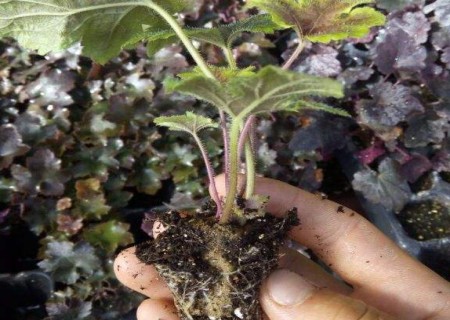
This is a Heuchera that has successfully rooted from a leaf cutting; fresh living roots have already grown out.
Gently take it out and you can see the roots. At this time, it can be temporarily planted.
This is the root system from leaf cuttings using peat + vermiculite + perlite.
7. Once the roots have grown sufficiently, the seedlings can be moved for temporary planting. For the temporary planting medium, use peat + perlite + vermiculite. Once the plant grows healthily, it can be finally planted and given normal care.
As a very popular foliage plant variety internationally today, Heuchera has been introduced into China on a large scale in recent years, but for some unknown reason, it has never been very popular among people in the north. Not long ago, classmate Aleng and I went to a flower market and met a shop owner who previously specialized in Heuchera. He sadly told us: “Heuchera is not popular in Beijing, and cannot compare with Shanghai, so I now sell succulents instead.”
I completely do not understand it. It is beautiful and easy to grow, cold-tolerant and shade-tolerant, and can be propagated by division or leaf cuttings. With a large pot, mix and plant several beautiful varieties together, and it feels like life is complete.