The correct method of trunk chopping and branch cultivation for tree stump bonsai
In shaping the branches of tree stump bonsai, the main goal is to create a beauty of lines. However, in practice, we also need to bring out various artistic embellishment techniques, trying to give the branches rise and fall, and a rhythmic sway, so that what we call “lines” can better express beauty. The extension of branches should show variation from multiple angles, combining soft and hard angles, with arc curves and curves together, using multiple bends and curves, with suitable lengths, so that the lines of the bonsai are natural and smooth yet full of variation, showing strength.
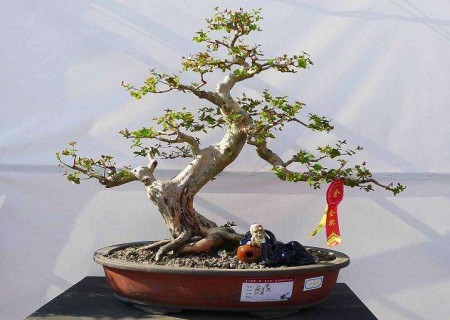
The branch layout and the beauty of lines in tree bonsai can only be completed through long-term embellishment and shaping in daily care and management. In the process of operation, we should proceed step by step, so that we can get closer to or achieve our expected design concept, and can continuously raise our pursuit of artistic taste and the value of our realm. In this respect, the method of trunk chopping and branch cultivation in Lingnan bonsai can best reflect this. Although the method of trunk chopping and branch cultivation is very time-consuming, it can better reflect the creator's technical skill and the gold content of their artistic level. Moreover, through continuous branch chopping and pruning, it promotes the plant's metabolism, is more conducive to plant growth, makes the budding effect more prominent, and lets the plant achieve a splendid transformation. This should be an important means of making tree bonsai.
The trunk chopping and branch cultivation we speak of here does not rely only on cutting and chopping; in fact, the means of wiring can also be used as an aid, and this is a method we can only use after the plant has been cultivated to a certain degree. The operation steps are: new stump cultivation - trunk chopping and branch cultivation - with cultivation as the key; combining pruning and wiring - wire first then prune - with pruning as the main method.
First, we need to cultivate the old stump of the plant for a period of time, so that the stump has a certain capacity to withstand it before trunk chopping can be carried out, and we must not seek quick success and instant benefits, otherwise it will result in twice the effort for half the result. Especially for the primary branches, we must give them enough time for cultivation; they must not be too thin, but they also must not be too thick. If the primary branches are too thin, it is very difficult to cultivate them to be thick and strong after branch chopping; if the primary branches are too thick, it will cause large wound cross-sections, and they will also be uncoordinated with the trunk. For secondary branches, tertiary branches…… we must all grasp the right degree, achieve just the right amount, so that the branches connect more harmoniously, match more reasonably, and display more beautifully.
Of course, the combination of pruning and wiring should not lean too much toward either side. In particular, branches that have not undergone proper wiring are very difficult to show a natural beauty, because after the branches have lignified, it is generally very difficult to bend them. If forced, not only is it difficult to achieve the desired effect, but the branches are also easy to break, causing irreparable damage to the plant. Therefore, before the branches lignify, we should properly carry out wiring and directional bending, and after the plant has taken shape, then carry out pruning and chopping. The beauty of bonsai branches is mostly completed through the techniques of wiring and bending. Therefore, creating bonsai through the method of combining pruning and chopping with wiring will not only shorten the time for the work to take shape but also increase its ornamental value.
When a tree bonsai becomes a mature tree, its branches will also continue to extend, and the crown will become more and more bloated. The inner branches will dry up year by year because they receive less and less light. At this time, we need to promptly adopt the method of reduction pruning to properly shorten the terminal branch tips, prune away dead branches, and at the same time continue cultivation, so that the entire bonsai work can restore and maintain a good posture.