How should a bonsai be pruned after its shape has been set?
The charm of plant bonsai is self-evident. It is precisely because of its extremely high artistic appreciation value that it has won the favor of a vast number of bonsai enthusiasts at home and abroad. To create an excellent piece, a great deal of effort is required in terms of shaping. Among the shaping techniques for bonsai plants, the most commonly used is still pruning and processing. But the pruning of bonsai must be determined according to the growth characteristics and growth vigor of the plant. So, how should a bonsai that is used for shape-setting be pruned? Below, the editor talks about his own experience and views based on personal experience.
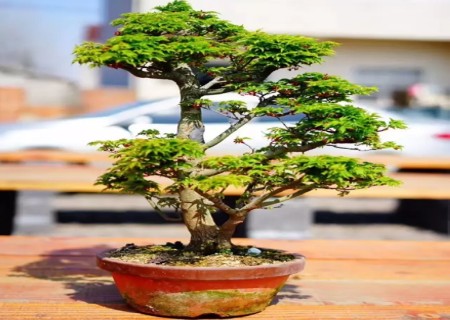
The principle of bonsai pruning is to retain healthy branches that are beneficial to shaping and cut off diseased and weak branches. The following are several common pruning methods, now shared with everyone, hoping to be of some help to you.
1. Thinning and pruning
Taking tree stump bonsai as an example, after the transplanted tree stump has survived being potted, we can set its shape. And the shape-setting of bonsai is mainly completed through pruning. As for thinning, it means we first need to cut off those excess branches and leaves on the tree stump that are useless for bonsai shaping, so that after pruning it can obtain better light, improve light penetration, and at the same time improve ventilation. After pruning those excess branches, nutrients can also be transported in a more concentrated way to the other retained branches, allowing nutrients to be absorbed more fully, and it can also shorten the growth time for the plant to take shape.
2. Controlling branches
After the tree stump has basically taken shape, we can carry out branch control treatment on the potted plant. Why is it called a potted plant here? Because we have not yet created a beautiful appearance for it, and it still does not have much artistic effect or ornamental value, so here using the term “potted plant” may be more accurate.
Because we previously pruned those branches and leaves that were not beneficial to shaping, nutrients will naturally be transported in a more concentrated way to the retained branches, and some branches are bound to grow too fast and too vigorously. In order to maintain the balance of the overall form, we now need to cut off a large number of branch tips or sprouted side branches. In this way, during the process of shaping the plant, we can allow those weak branches that are beneficial to shaping to receive sufficient nutrients and at the same time receive more light, making them more conducive to the shaping of the entire plant.
3. Pruning with leaves
When we prune branches, we must cut off the small branches and leaves together, but what if we encounter places where there are no leaves? Do we not need to prune there? In fact, even where there are no leaves, we still need to prune appropriately. But at this time we need to follow the branch nodes along to a place with leaves before pruning, but we must not prune excessively, as the saying goes, going beyond the limit is as bad as falling short.
Why must we prune with leaves? Pruning with leaves is a preventive measure against the possible shrinking of the pruning cut causing the appearance of withered branches and fallen leaves. It is mainly to ensure that our pruning can proceed smoothly, and apart from bringing convenience to the shaping of the plant, it must not affect the normal growth of the specimen.
Having said so much, it is time to summarize. In fact, the beauty created through pruning is best when it makes the entire plant appear more natural. According to different personal understandings of bonsai art and ornamental value, the forms created will also vary greatly and each has its own characteristics. Therefore, in the process of pruning, we can completely proceed according to personal preferences and complete it according to personal creative ideas. There is no need to blindly imitate and follow a fixed model, because bonsai is an art, a manifestation of beauty. As long as the work you prune out has relatively high artistic expression and ornamental value and can be accepted and loved by most people, then it is a good work.