Illustrated Guide to Softwood and Hardwood Cuttage Techniques for Buddhist Pine (Podocarpus macrophyllus)
Good evening, fellow bonsai enthusiasts. I have a bit of free time again today, so I've come back up to discuss with everyone the knowledge of propagating Buddhist pine (Podocarpus macrophyllus) through cuttings. Perhaps, when it comes to propagating Buddhist pine, some enthusiasts grab a hoe and head out to dig up wild mountain-collected stumps, but today this editor is still staying at home practicing basic skills.
Digging up finished specimens from the wild is of course better than anything, but this editor is not one to take the easy way out - this editor is someone who loves to tinker. Without further ado, let's get straight to the point. Today this editor will discuss with fellow enthusiasts the softwood and hardwood cuttage techniques for Buddhist pine.
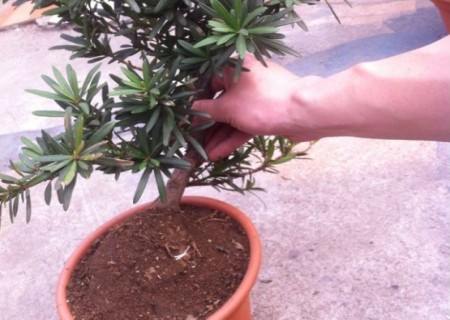
1. First, we need to find a well-grown potted Buddhist pine specimen tree.
2. Select healthy, vigorous branches and cut them off to use as cuttings. The photo below shows the branches that have been cut off.
3. Then, from the cut branches, take a softwood section about 10 cm long as the cutting. The softwood is a one-year-old, semi-lignified branch.
4. Then take a hardwood section about 15 cm tall; the branch must have complete side branches, and a thickness of 1-2.5 cm is suitable.
5. Since the tip of the hardwood has a cut end, you can apply the ointment shown in the photo below to the cut end to seal it.
6. Now remove the leaves on the lower 2/3 of the softwood to reduce excessive water evaporation; if you use scissors to cut them off, be sure not to damage the bark of the cutting.
7. Use a sterilized knife to cut the base of the hardwood into a horseshoe shape, symmetrical on both sides.
8. After preparing these branches, soak them in a rooting solution and carbendazim solution for 2 hours to sterilize and disinfect, while also laying a good foundation for rapid rooting.
9. After soaking, take the branches out and place them in a cool, well-ventilated spot to air-dry the moisture.
10. Next is preparing the cuttage substrate; it is recommended to use sterilized coarse river sand as the growing medium.
11. When inserting the cuttings, first use a chopstick to poke appropriately sized holes in the growing medium at irregular slant angles, so that after cuttage the cuttings grow into different shapes, then insert the cuttings into the holes.
After completing the above steps, the cuttage is done, and what remains to be done well is the care and management work.