Detailed Explanation of Key Techniques for Softwood Cutting Propagation of Figs
The fig softwood cuttings bought online finally arrived after 3 days. The fig branches were not only softwood cuttings, but also had terminal buds. Because the summer weather was relatively hot and the journey took another 3 days, after receiving the cuttings it was obvious that the cut ends had already turned somewhat black, and the condition of the branches looked quite ordinary.
Since this was the first time doing a cutting propagation experiment, they were divided into two test groups: one group used water culture cuttings, and the other group used soil culture cuttings.
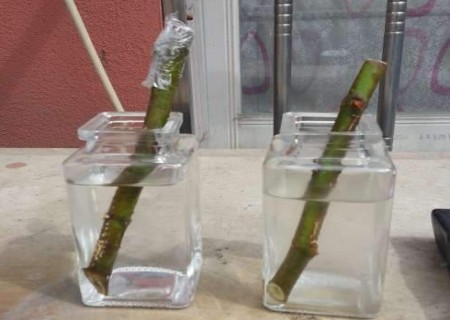
1. Before cutting, these cuttings were first disinfected. All of them were sprayed with a carbendazim solution, and then the cut portions were soaked briefly in a rooting solution.
2. After 2-3 days, it could be seen that the base of the cuttings propagated by water culture had already developed some white dots, while the soil-planted branches still showed no obvious change.
3. After several more days, the white dots on the water-cultured cuttings became more prominent, and the leaf buds also began to turn green. At this time, 2 drops of nutrient solution were added to the container. But by then the soil-planted branches had already begun to sprout.
4. After another 4-5 days, the white dots at the base of the previously water-cultured cuttings had turned into white roots, and the leaf buds were also clearly visible. At this time, the water was replaced with clean water, and 5 more drops of nutrient solution were added. By then, the soil-planted branches had already grown 2 tender leaves.
5. After about another week, whether water-cultured or soil-planted, the terminal buds and lateral buds of the cuttings had all unfolded, and the plants had basically survived.
During the above cultivation process, the water-cultured branches were kept outdoors with normal direct sunlight and no shading measures were taken; the soil-cultured branches were always placed in a shaded outdoor environment, with only 4-5 sprays of water per day to keep the branches moist. But by comparison, the soil-cultured cuttings rooted and sprouted noticeably faster than the water-cultured ones.
In fact, whether water-cultured or soil-cultured, peach tree cuttings can both survive. It is just that compared with water culture, soil culture has more advantages in rooting and sprouting. But during the cultivation process, disinfection and moisture retention are indispensable steps.