How to graft potted Camellia sasanqua? Detailed explanation of grafting techniques
Many potted flowering plants can be propagated into young plants by grafting, and Camellia sasanqua is no exception. Although Camellia sasanqua can also be propagated by grafting, grafting is relatively difficult and the survival rate is relatively low. Therefore, to improve the grafting success rate of potted Camellia sasanqua, we must master the key operating points; otherwise, carrying it out will yield half the result with twice the effort and may even lead to failure.
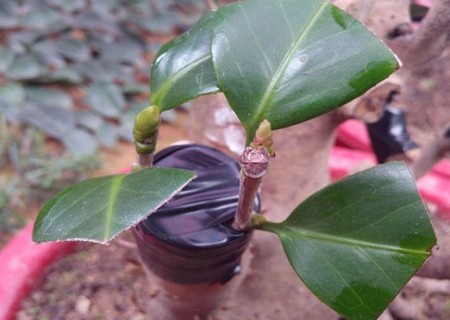
Grafting is a skill and a meticulous task; to succeed, one certainly must not be careless. In addition to mastering the grafting method, one must also be able to flexibly handle various detailed problems that may arise. Only in this way can our grafting process succeed. So, how is Camellia sasanqua propagated by grafting? Today the editor will explain the grafting techniques for potted Camellia sasanqua.
1. Scion selection
The selection of scions should be based on choosing the right variety; as much as possible, choose varieties with a similar or close plant shape and growth vigor, and it is also recommended to choose different varieties of the same tree species as cuttings. More importantly, be sure to choose robustly growing branches. Only when all the above conditions are met can a foundation be provided for improving the grafting success rate, and only then is it possible to achieve the expected grafting results.
2. Grafting time
Camellia sasanqua is mostly grafted from May to September, because during this period the rootstock absorbs nutrients and water very sufficiently and grows very vigorously. Choosing robust scions and rootstocks for grafting during this period can better improve the grafting success rate and survival rate. Practice has shown that June to July each year is the best period for grafting Camellia sasanqua, because the temperature during this period is relatively suitable, the scions of Camellia sasanqua have basically completed semi-lignification, and the transplanted rootstock seedlings have also fully survived, so the grafting success rate is very high.
3. Grafting process
There are many grafting methods for Camellia sasanqua, including bark-tearing insert grafting, triangular insert grafting, green branch grafting, and water cutting grafting. However, for Camellia sasanqua grown as potted plants, green branch grafting is mostly used to propagate and cultivate young trees. This method grafts semi-lignified scion branches onto new rootstock branches that have not yet become semi-lignified, and the grafting process is usually completed by cleft grafting. The general operation is as follows:
First complete the basic grafting steps using the cleft grafting method, then cover the grafting site together with the scion using a thicker transparent plastic bag, and then put a light-blocking kraft paper bag or another tool that can achieve the same effect on the outermost layer. This can block most strong light and provide conditions for normal growth of the grafted part. After the graft survives, remove the paper bag and then the plastic bag, in that order from outside to inside.
When grafting in this way, because both the rootstock and the scion are relatively tender branches, their cambium layers are relatively thick, the wounds produced during grafting can heal more quickly, and the grafted products have a higher survival rate. It is one of the main methods for grafting and propagating potted young Camellia sasanqua trees and is relatively suitable for potted plant enthusiasts to try.
4. Later management
After the grafted young Camellia sasanqua trees have fully survived, we must not relax in management either; instead, we should work harder to improve it and ensure the plants take shape and have a good ornamental effect. The main management measures focus on the following aspects:
1. Trunk cutting treatment
One month after grafting Camellia sasanqua, promptly inspect the wound healing. If it has healed very well, it is recommended to saw off half or even more of the rootstock 2-3 cm from the scion, and at the same time lower it appropriately. At this time, generally do not cut the rootstock off directly, because the scion is not yet able to obtain water and nutrients and needs to obtain them through the rootstock. It is recommended to wait until 2 months later, after the axillary buds of the scion have sprouted, before completely cutting it off.
2. Loosen the binding in good time
When the axillary buds of the scion have all fully grown out, we can then loosen and untie the film previously used to seal the graft; after about another 3 weeks, once its growth is stable and sturdy, the binding material can be completely cut off, so as not to hinder its continued normal growth and development process. At this time, better light conditions can also be gradually added for the plant.
3. Remove sprouts
As the grafted Camellia sasanqua continues to grow, many young buds and young branches will sprout from the rootstock, and their growth is very rapid, so they should be removed in time; otherwise, they will seriously affect the normal growth of the scion, causing the plant to grow slowly, hindering development, and resulting in poor growth. In more serious cases, the plant may become thin and withered yellow. This is because the sprouting young branches and buds will compete for and take away the scion's nutrients and water, and if the scion cannot obtain enough nutrients and water for growth, it will face a survival crisis.
4. Train the tree shape
After Camellia sasanqua grafting succeeds, the process of training the tree shape is especially important, and it must be done appropriately and at the right time. Scientific and reasonable tree-shape training measures are not only more conducive to maintaining a good shape for the plant, but can also make all parts of the branches and leaves of the entire young tree grow in a more balanced way. Everyone can appropriately adjust the tree shape and branches according to ornamental needs, and at the same time can complete it by combining methods such as bending, binding, and directional stretching of the tree shape. (Author: Xiaoshu 22:38)