How to Expose the Roots of a Broom (Genista) Bonsai for Styling? A Complete Guide to the Methods
Broom (Genista) is famous for its flowers that bloom in the shape of a bird soaring on outstretched wings, and its bright, striking colors bring vibrant life to any setting. The roots of broom are even more gnarled and powerfully rugged, and they are highly flexible, making them easy to twist into shape, which makes it an excellent species for creating bonsai. So a broom bonsai is not only enjoyed for its flowers, but also for its roots.
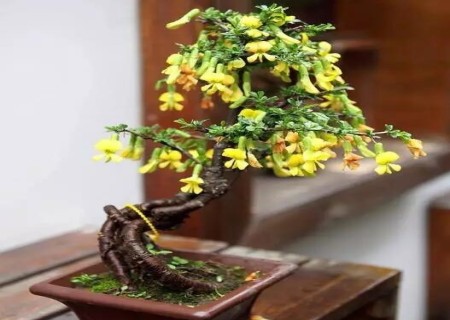
In recent years, broom bonsai have become increasingly favored by modern households. Bonsai trees vary in size, and a bonsai can also show the large within the small, forming a grove all on its own; what is more, its base has twisting, interlocking roots that are rugged and majestic, giving a delightful visual pleasure and possessing very high ornamental value and artistic effect. So how do you style the roots of a broom bonsai? The usual way to style the roots of a broom bonsai is through root exposure treatment. Below, the editor shares several methods for styling exposed roots.
1. Sleeve Method
For some broom bonsai trees that are difficult to induce adventitious roots on, we can achieve the goal of exposed-root styling by using a sleeve after the crown has been pruned and shaped. Generally, a girdling treatment is carried out on a branch at a certain height above the pot surface: first girdle the bark once, then girdle the trunk once, and then cut a section of a plastic bottle to place as a sleeve over the girdled area. Put some rooting soil into the sleeve, then water it at the right times to keep it moist, and remove the sleeve after about 2-3 years.
After removing the sleeve, we will find that many roots of various sizes have already grown inside the sleeve. However, we cannot keep all of these roots at this point; we need to select and keep the best ones, retaining those that grow thick and strong, with the root heads pointing upward and the root tips drilling downward into the potting soil. Of course, we also need to keep some relatively smaller roots that grip downward into the ground, letting them hug the terrain like dragon claws.
2. Mounding Method
For broom bonsai trees whose base trunk can sprout many adventitious roots, we can achieve the goal of exposed-root styling by mounding soil. This method is generally carried out in spring. You can artificially make some cuts at a certain height on the base trunk, then mound rooting soil over the wounds, and then water so that the rooting soil stays moist to encourage root sprouting.
Likewise, after about 2-3 years, when we dig away the rooting soil, we will find that the newly sprouted roots have gradually aged. At this point, we can appropriately trim and shape these roots according to personal preference to make them better fit artistic characteristics, while also achieving the goal of exposed-root styling.
3. Root-Lifting Method
Root lifting, namely a root styling process carried out to give a tree bonsai better artistic presentation and ornamental value. After root lifting, a bonsai tree appears more ancient and rugged, while also looking venerable and dignified, with even greater artistic charm.
Broom bonsai can also adopt the root-lifting method to achieve the goal of exposed-root styling, but it is generally done in combination with repotting, and it is lifted upward only a little each year. Never lift it too high at once, otherwise it will affect the tree's survival and growth. Root lifting is meant to expose the broom's roots on the pot surface as much as possible, while also removing the fine and keeping the strong, removing the dense and keeping the sparse, and preserving the unusual roots as much as possible. In this way, we can create a broom root styling art with clawing, bared heads and drilling tails, both unique in style and each with its own merits, multiplying the value of the broom bonsai.