How can plum bonsai look aged and rustic
Old plum bonsai are elegant, free-spirited and full of spirit, and are highly favored by bonsai enthusiasts. Plum bonsai not only bring us beauty, but also add a lot of fun to life. But a plum bonsai with considerable ornamental value and artistic effect must first of all have an antique and senile appearance and posture, so many bonsai artists use the technique of gnarled, twisted and layered branches to create old plum bonsai.
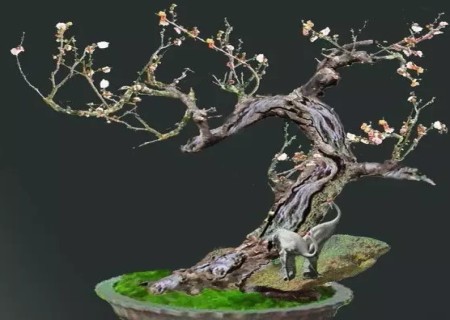
Plum trees are relatively easy to propagate, have quite a few varieties, and are also fairly easy to shape. Raising plum trees by growing seedlings is a good way to cultivate plum bonsai later on. However, plum bonsai cultivated by conventional methods will be flawed because they lack a sense of age and rusticity. So how do you turn a plum tree into a rustic, aged plum bonsai?
1. Lure insects to bore into the wood
In seasons when ants and other insects are very active, we can use a tool to manually cut open the phloem of the plum tree, drill a hole in the xylem, and then inject some honey into it to lure ants to feed on the sugar while gnawing at the xylem. After repeating this method several times, along with proper pruning and shaping, the plum tree can quickly become a rustic plum bonsai with a strong sense of vicissitude.
2. Split the trunk to create scars
Generally speaking, the front of a plum bonsai is the viewing side. To make it look aged, we can also achieve this effect through artificial intervention. Usually a carving knife can be used to cut the bark appropriately, then peel off some of the outer bark, and then use a chisel to remove 1/3 of the xylem in a grooved manner. Of course, do not remove too much xylem, otherwise it is easy to damage the tree's core and affect its growth or even its survival. After this treatment, over time the wounded parts of the tree will slowly form scars and look very aged. Of course, this is also the effect we want.
3. Carve and shape scars
This method is also carried out on the viewing side. First peel off part of the bark, use a chisel to cut holes of different sizes in the xylem of the trunk, and then embed small stones of suitable size into them. Carving and scar shaping must not be excessive, and this needs to be flexibly adjusted according to the tree's tolerance and the size and shape of the tree. Otherwise, not only will it fail to create the senile effect we need, but it will also backfire.
4. Embed seedlings
First we need to choose an old stump that is dead but has a very beautiful posture. In order to create the rustic, aged visual effect we need, we first need to carry out simple pruning. Generally, prune away overly long branches and dead branches that affect the shaping effect, then chisel a groove downward on the back of the old stump, and then embed plum seedlings into it. Of course, to ensure the seedlings survive, remember to fill it well with soil and moss, then spray some water, and afterwards tie it up with rope. After a long time, once the main trunk of the seedling grows thick, it will fill the groove, and once it is stable, remove the rope. Using this method to create an old stump generally makes obvious traces hard to find, looks more natural, and achieves a effect that passes fake off as real, giving people a visual experience of a dead tree coming back to life.
5. Manually break branches
Usually, when shaping bonsai we generally use pruning and tying methods, but to create plum bonsai we generally use the method of breaking branches and then tearing them apart. This method generally needs to be carried out multiple times, and the number of branches torn each time should not be too many, otherwise it will affect the normal growth of the old stump. After repeated breaking and tearing of branches, once the wounds on the xylem at the base of the branches heal, corresponding tree scars will form, giving people an image of having endured wind and rain, with a strong sense of vicissitude, while also highlighting a kind of natural beauty.
6. Pry open the bark
In order to create the rustic, aged feeling we need in plum bonsai, we can also accomplish this by artificially prying open the bark so that it separates from the xylem. After the bark separates from the xylem, as time passes, the wound will gradually heal, but by then a raised, protruding part shaped somewhat like a tumor will have formed. This method must also be used in moderation, especially in terms of quantity, which must be well controlled, so as not to cause too deep damage to the old stump.
7. Hammer the old stump
In addition to the above methods, we can also achieve the effect we need by hammering the old stump. This method looks rather violent, and the force is not easy to control, so we need to act cautiously. But this method is very effective. By hammering the tree body, the old stump will inevitably show uneven shapes. Because local damage accelerates cell division, the hammered parts will form wound healing tissue and grow unevenly, with local raised areas appearing. This method can likewise make the plum bonsai display an aged and rustic posture. (Author: Xiaoshu 2017-09-20 23:05)