Clematis cutting propagation illustrated tutorial, a step-by-step guide to help you master it
Clematis is a perennial herbaceous plant. Although its stems and vines are relatively slender, they can grow very long, and they are very sturdy and quite tough, which is why people call it clematis. Even though the stems and vines are slender, the flowers it blooms are very beautiful, the flower colors are fairly rich, and the fragrance is pleasant. It can not only be used as a cut flower, but is also the top choice for climbing flowering plants on courtyard fences.
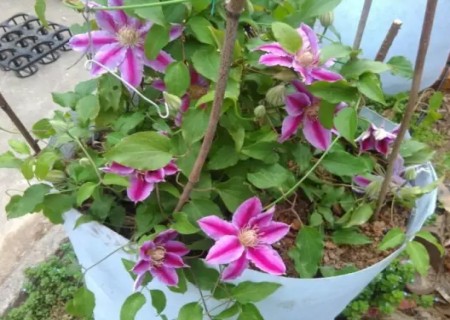
Of course, clematis can also be grown as a potted plant, and it is likewise very beautiful, with an irresistible fragrance. Clematis has many propagation methods, mainly including sowing, cuttings, layering, division, and grafting. But when it comes to being simple and easy to do, propagating by cuttings is still recommended. So, how do you take clematis cuttings? What the editor is sharing below is an illustrated clematis cutting tutorial.
1. First, prepare the cuttings. It must be emphasized here that it is recommended to take branches that have already bloomed as cuttings. This is because branches that have bloomed contain a large amount of nutrients, making them easier to root after cutting!
2. Cut the clematis stems and vines taken from the potted mother plant into small segments to serve as cuttings, but make sure each cutting retains at least 1 pair of leaves.
3. Prepare some black sponge blocks. This can create a dark growing environment for the cuttings, because in a dark growing environment, clematis cuttings are more likely to develop roots and the survival rate is improved.
4. Next, make small holes in these prepared black sponge blocks, with a size matching the diameter of the cuttings. Then insert the cut cuttings into the sponge blocks, following the practice of inserting one cutting per black sponge block.
5. After completing the cuttings, use a thin wire to loop around these cuttings to hold them in place. The method is: use thin wire to secure these clematis cuttings to the inner wall of a foam box. Finally, move the foam box together with the cuttings to a cool and ventilated environment for care and management.
6. During the care and management process, the most commonly used management measure is replenishing water. Timely watering can help the cuttings develop roots. After about 1 month, the clematis cuttings will begin to show rooting. (Author: Xiaoshu 2017-08-27 21:52)