How to shape a plum blossom bonsai? Master these methods for a more beautiful tree form
From ancient times to the present, the plum blossom has always been seen as a symbol of unbending integrity, braving the harsh winter and blooming alone in the cold. If you make a plum blossom into a bonsai and place it in your home, it is not only very elegant but also excellent in both color and fragrance, bringing a delightful enjoyment. However, to obtain a plum blossom bonsai that is durable for viewing and has considerable artistic value, the shaping process is very important.
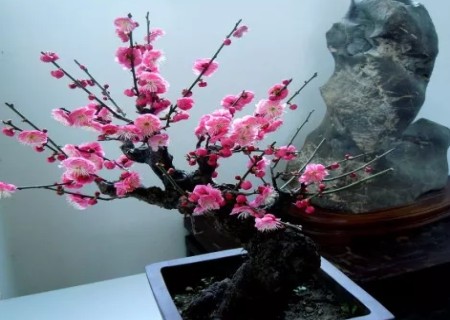
In terms of the schools of plum blossom bonsai, there are differences between formal and natural styles, divided into traditional shaping and modern natural plum trunk shaping. Traditional shaping is mainly based on lumpy plum, split plum, downwind plum, screen plum and roaming dragon plum; modern natural plum trunk shaping is often mainly based on straight-trunk plum, slanting-trunk plum, curved-trunk plum, double-trunk plum and cliff-hanging plum. So how are common plum blossom bonsai shaped?
Common plum blossom bonsai are mostly plum trunk bonsai, and shaping is generally completed by means of pruning, wiring, bending, carving and grafting. Below, the editor briefly introduces these shaping methods.
1. Pruning
For natural-style plum trunk bonsai, pruning is generally used for shaping, but pruning is divided into formative pruning and corrective pruning. Formative pruning is mainly about establishing the basic framework of the plum trunk through pruning, usually carried out in winter; corrective pruning is mainly about cutting off branches that are unfavorable to the shape, such as the common parallel branches, overlapping branches, dead branches, diseased and pest-infested branches, and crossing branches.
2. Wiring
In the previous article, the editor mentioned that the shaping of plum blossom bonsai should follow the principle of "coarse wiring and fine pruning." The wiring method of shaping is a traditional practice in our country, but it is used quite widely. It can be carried out when the diameter of the main trunk reaches 1 cm, and the side branches can also be appropriately wired with palm rope or metal wire. However, after the shape is set, the wiring tools should be removed in time to avoid damage to the branches. There are also many wiring methods, which can be chosen according to shaping needs and personal preference.
3. Bending
Sometimes, in order to achieve the shaping effect we need, it is also necessary for us to operate by means of bending. The method is to use hanging, sawing and folding, or stabbing the trunk on the main trunk or main branches to make them achieve a bending effect. By working on parts or details, the plum tree can be changed in shape as a whole, so that it achieves the effect we need. The specific method used to accomplish this depends on our design needs.
4. Carving
Carving is generally carried out as appropriate after the basic shaping of the plum trunk has been set or completed. The purpose of carving is mainly to make the plum trunk show an aged appearance while still being full of natural rustic charm. For the entire bonsai work, this often plays a finishing touch or adds further beauty, and can even make up for imperfections caused during the shaping process.
5. Grafting
Grafting is like performing a major operation on the plum trunk, or more accurately, it is to better create a beautiful shape. On the one hand, it can improve the external form of the plum trunk; on the other hand, it can supplement the missing branch parts of the plum trunk; and another aspect is that it can improve the variety of the trunk crown. There are also many grafting methods, mainly branch grafting, approach grafting and bud grafting. Since these were introduced in previous articles related to tree stump bonsai, the editor will not go into them one by one here.