Detailed Explanation of Red Plum Bonsai Shaping Techniques and Methods
Red plum can not only be grown as a potted plant in the courtyard to beautify the environment, but can also be made into bonsai for viewing. But if we want to shape it into a bonsai, we need to master certain pruning and shaping techniques. So, how do you shape a red plum bonsai?
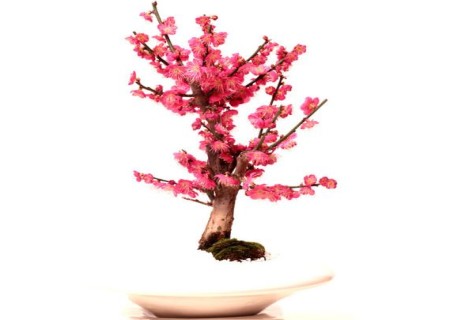
Plum bonsai is an excellent traditional Chinese art, especially red plum bonsai. It can bloom in winter with a proud posture, bringing a touch of warmth and festivity to people in the cold winter. In order to let it show its unique charm, today the editor will share its shaping techniques with everyone.
The shaping of red plum bonsai mostly adopts the method of "coarse wiring and fine pruning." When the diameter of the red plum trunk reaches about 1 cm, we can begin wiring it. Because its branches tolerate wiring, we can also use palm fiber or metal wire to appropriately bind its side branches.
For the flowering branches newly sprouted that year, we can, according to the needs of the shaping design, also use palm fiber or metal wire to appropriately wire them. Especially in winter, the trunk and large branches of the red plum should also be appropriately processed and shaped. If they are new branches, it is best to process them in September, but the operation needs to be careful to avoid damaging the flower buds.
In terms of tree form, in order to let the red plum bonsai display an elegant posture, we need to put in even more thought. Plum bonsai mostly takes "curvature" as beauty; if it is too upright and straight, it appears to have no posture, and looks inelegant, and to a large extent loses its ornamental value; if "lean" is taken as beauty, if it is too regular and upright it does not form a scene; if "sparseness" is taken as beauty, once the branches are too dense it cannot reflect its branches......
In our country, red plum bonsai is often shaped and designed according to the above standards. The key point is that generally a horizontal and slanting trunk is considered elegant, and the branches and leaves are best left to stretch freely. Especially the branches and leaves, appropriately reducing them and letting them show a relatively sparse state, with the blooming red plum flowers setting each other off, can better show the refined charm of the bonsai. But they cannot be made too sparse; density and sparseness must be appropriate, letting the flaws not obscure the virtues and the virtues not obscure the flaws, so that the red plum bonsai work can show poetic and painterly charm.