How to graft a winter jasmine bonsai? Detailed methods and steps
Winter jasmine (Jasminum nudiflorum) can be improved by grafting, making it easier to shape into an excellent bonsai. For grafting winter jasmine, species such as wild winter jasmine and Jasminum floridum can be used as rootstock, and the grafting results are very good. Of course, water privet (Ligustrum) seedlings can also be used for grafting, usually in early spring when growth begins to stir; choose a suitable height for side grafting (inlay grafting), and complete the winter jasmine grafting this way, which can also achieve good results.
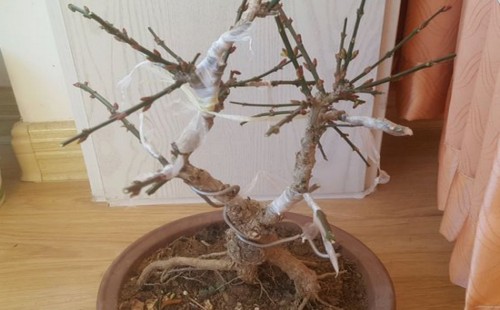
Side grafting is a commonly used grafting method, but if water privet seedlings are used for side grafting, usually choose water privet seedlings with a diameter at breast height of 2 cm or more, and at a suitable time select a height of about 1 m or another spot you consider suitable but that will not affect grafting survival, and perform the side graft there. Generally, cut a current-year winter jasmine branch about 8-10 cm long as the scion, then carry out the grafting operation.
After the scion is inserted, we also need to promptly wrap it with plastic film, and if necessary, even bag it, mainly to protect against cold and keep warm, and also to keep the scion moist. When the graft has taken and tender new shoots and leaves emerge, promptly pierce the plastic film to allow ventilation, ensuring the hardening-off process is completed smoothly. Later, timely pinching is also needed to encourage the grafted seedling to sprout more side branches and fill out the plant shape; at the same time, strengthen the training of the crown to make the crown shape more ornamental.
How do you graft a winter jasmine bonsai? Besides cutting perennial branches to make scions for side grafting, we can also use budding to complete the grafting, and can even use multiple methods at the same time to graft vigorous branches. Below is the grafting process. Now shown to everyone in pictures:
1. Prepare tools and materials, including rootstock, scions, tools, and so on.
2. On a perennial branch, choose a relatively smooth spot, then make the graft opening on the branch near the lower branching point. Because winter jasmine is usually pruned after flowering each year to retain only 1-2 pairs of buds, and the growing parts are compressed as short as possible, so that the tree shape looks more compact and beautiful. Therefore, the grafting site should be close to the base.
3. Cut a one-year-old branch as the bud-grafting scion. Once preparations are complete, you can insert the scion into the grafting site.
4. In addition to the above two grafting methods, side grafting and bud grafting, we can even use cleft grafting to continue grafting.
5. Of course, there is also a relatively rarely used grafting method, namely cutting current-year branches and using chip budding to complete the grafting.
In fact, winter jasmine grafting can be done on a single plant by grafting many branches with vigorous growth, and after they survive, cut back the rootstock to prompt the grafted seedlings to sprout quickly. In this way, the grafting activity generally will not have much impact on the rootstock's flowering.
But then again, even if the grafting fails and the grafted seedlings do not survive, it will not affect the continued growth and shaping of the rootstock. However, we hope even more that the grafting succeeds and the grafted seedlings sprout and grow smoothly, so that next year we can see the beautiful sight of the new variety blooming on schedule.