How Short Should You Cut Elm Bonsai Branches? A Detailed Guide to Pruning Methods
Elm is a deciduous tree, and generally, whether for routine care and management or for bonsai styling, pruning is usually the primary method used. Pruning an elm bonsai is mainly done to shape a good tree form, so we cannot simply focus on pruning alone; during the pruning process, we should also appropriately consider leaving some branches unpruned, so as to facilitate styling design.
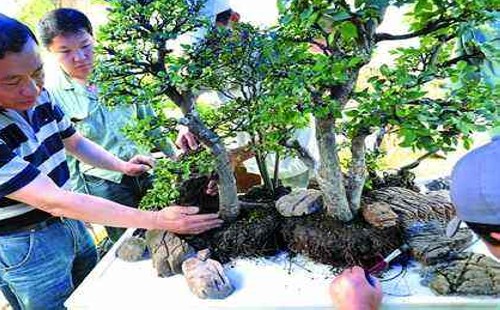
As for what to prune, the first things to remove should be dead branches, diseased and weak branches, and other branches that are useless for growth and styling; keeping them only wastes nutrients and actually weakens the tree's vigor. Of course, to promote plant growth and make the tree form more attractive, branches such as water sprouts, crossing branches, parallel branches, overlapping branches, and reverse-growing branches also need appropriate pruning. Even some branches that grow vigorously but detract from the beauty of the design should be removed as well.
Branch trimming and pruning of elm bonsai are mostly carried out in winter, because winter pruning can save some nutrient consumption and is more conducive to the plant's sprouting and new branch growth after spring the following year. For bonsai trees that have already been shaped, pruning during this process is mainly control pruning. For an elm in its growing season, it is not advisable to cut off newly sprouted tender branches. So, how short should elm bonsai branches be cut?
Pruning is relatively meticulous work. For bonsai trees, it is generally difficult to achieve the result in one step; usually, repeated pruning operations are needed over time to achieve the effect of stabilizing the tree form and maintaining its beauty. As for how much elm bonsai branches need to be pruned and what length is appropriate to cut them to, this mainly depends on the type of branch being pruned. Here, we cannot make a blanket generalization.
During pruning, it is usually necessary to use heading back and short cutting to reasonably control branch length, while overly dense branches should also be thinned out. Everyone knows that by pinching and topping, you can control the height of the tree form and promote the plant to sprout side branches; this is a form of vertical pruning. Then, after a large number of side branches have sprouted, we also need to control the size of the tree form through horizontal pruning. The simplest and most effective way to control horizontal growth is to head back branches that grow almost horizontally, using reduction pruning to carry out the operation.
In pruning elm bonsai branches, besides completely cutting off dry, diseased, and weak branches at their base, overlapping branches, clustered branches, and water sprouts generally do not need to be retained either. However, sometimes because the branch distribution is rather unusual, some areas become too empty, so it is necessary to keep some branches, such as water sprouts, and use bending, stretching, and other methods to fill them in, making the tree form fuller.
For pruning ordinary branches, the length to retain is mainly appropriately controlled according to the needs of the styling design, keeping it moderate in length. On the one hand, by not heading back or reducing branches, the tree's vigor will not be weakened, and the plant can be better stimulated to sprout; on the other hand, it can also maintain a good tree form and styling effect without reducing the ornamental value of the bonsai. The length to which branches are pruned should vary from tree to tree and according to the needs of different styling designs.