Elm Bonsai Branch Bending Methods and Techniques Explained
Bending is a shaping technique often used in the process of creating bonsai works, and before carrying out the operation, we need to master certain skills, otherwise the bending may fail and instead cause damage to the branches, thereby weakening the tree's vigor while also affecting the display of its ornamental value. Many people always end up breaking branches simply because they have not mastered the basic bending technique.
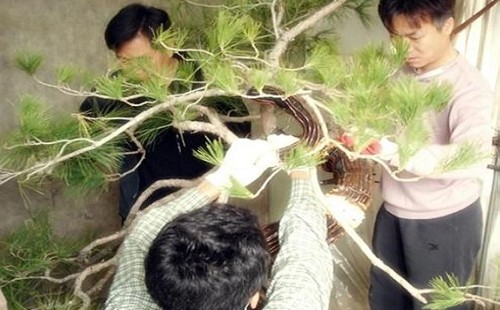
In the process of creating elm bonsai, the bending technique is also often used, and bending usually requires the aid of metal wire for wrapping and shaping to change the direction of the branches, making the branch distribution more reasonable, which is very important for the styling effect of the bonsai. The metal wire most commonly used for bending is aluminum wire. So, how do you bend the branches of an elm bonsai? Below, the editor will share with you the branch bending methods for elm bonsai.
Before carrying out the bending operation, we first need to choose aluminum wire of suitable thickness, which usually needs to be determined according to the thickness of the branch to be bound. Usually, the thickness of the selected aluminum wire should be about 1/3 of the thickness of the branch. This is because the flexibility of the branch should be proportional to the flexibility of the aluminum wire, and when binding, the aluminum wire needs to be kept close to the outer bark of the branch, so that the branches can be better distributed and the shaping effect can be achieved.
At the same time, when the aluminum wire is wound at the point to be fixed, it should be wound at a 45-degree angle. That is, at this angle, the diagonal aluminum wire is bound onto the branch, forming a 45-degree angle with the branch, so that the upper and lower force points appear more balanced, making it less likely to break the branch or injure the bark too much, and minimizing the degree of damage to the branch. Therefore, we must not blindly carry out binding and bending of branches.
Moreover, in the process of binding and bending, it is recommended to wind double aluminum wires in the same direction, especially at the starting point of a forked branch, where a suitable support point or force point must be selected, and the direction of winding the aluminum wire should be kept in the same direction as the aluminum wire being bound, so that as far as possible the aluminum wires do not interweave or overlap with each other. Also, when winding the aluminum wire, it should be kept as close as possible to the outer bark of the branch, and the external force applied should not be borne entirely by the branch, so as to avoid causing excessive damage to the branch. Therefore, we should find multiple force points to disperse the effect of the external force, and even when necessary, let the hand bear part of the external force.
In the process of bending a branch, especially after the aluminum wire has been wound onto the branch, we must adjust the direction and bending arc of the branch along the winding direction of the aluminum wire. Also, when adjusting the bending degree of the branch, one hand should tightly pinch the fork part of the branch being bent, to prevent the branch from being torn from the fork. And when bending along the direction of the aluminum wire while finding a force point or support point, the outer bark should be pinched or gently rubbed in advance to give the branch a certain flexibility before carrying out the operation, which can effectively avoid the branch breaking or snapping.