Can roses be propagated by cuttings in summer? Detailed cutting method
Roses have long been crowned with the reputation of “queen of flowers,” because potted roses grow elegant and graceful with beautiful posture, and their flowering period is very long, blooming from August of the previous year to April of the following year. If you place a few potted roses on your balcony, they will undoubtedly become a beautiful scenery.
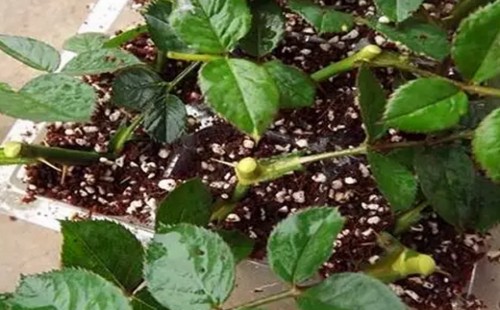
Roses are not only gorgeous in bloom with high ornamental value, but also relatively simple to propagate, mostly using cuttings to breed small potted plants. To improve the survival rate, rose cuttings are usually taken in autumn from September to October, because the temperature during this period basically stays between 20°C-25°C, which is very suitable for cuttings, and the survival rate of cuttings can even reach over 95%. It can be seen that choosing the right season and taking rose cuttings in a suitable environment results in a fairly high survival rate.
So, can roses be propagated by cuttings in summer? Everyone knows that the temperature in summer generally reaches above 30°C, and the sunlight is very intense, which easily leads to cutting failure due to hot and humid weather. For this reason, many potted flowers and plants are not suitable for cutting propagation in summer.
Practice has proven that roses can be propagated by cuttings in spring, summer and autumn. Although compared with spring and autumn, when the temperature environment is more suitable and the light is not too strong, cutting propagation has a higher survival rate. Summer temperatures are often relatively high, and when taking rose cuttings, the survival rate is often affected to some extent. However, this does not mean that cuttings cannot be done in summer. As long as we can provide a suitable cutting environment, roses can also be propagated by cuttings in summer. Below, the editor will share with you the method for taking rose cuttings in summer!
First, we need to select relatively robust branches from the lower part below the flower as cuttings, because the nutrients in the rose plant were previously transported in a concentrated way to the flowers and leaves at the top, and after the flowers fade, the nutrients gather in the lower part of the plant, mainly to promote the sprouting and growth of axillary buds and to continue providing nutrients needed for the second round of flowering. Therefore, we should choose branches below the flower as cuttings. In this way, the nutrients in the cuttings are richer, and their development is better, so the survival rate after cutting is relatively higher.
When cutting the branches, cut a stem segment with 5-7 compound leaves from a robust branch below the flower as a cutting; at the same time, the stem segment is required to have 2-3 buds. Before cutting, part of the leaves on the stem segment needs to be cut off to reduce water evaporation, because leaves can evaporate a large amount of water. Of course, the leaves and petioles at the lowest end of the cutting used for insertion should be removed together, to avoid inserting the lower leaves into the substrate during cutting, otherwise they are prone to rot and breeding pathogens.
Next, prepare a moist cutting substrate with suitable thickness and strong permeability, then insert the lower end of the cutting into the substrate to a depth of 30%-40% of the cutting. If inserting multiple cuttings, pay attention to controlling the distance between them. Then gently press down the moist soil around the cuttings. After completing the cuttings, water them thoroughly once, cover the cuttings with plastic, and place them in a shady spot to avoid direct sunlight and reduce water evaporation.
Before the cuttings take root and sprout, in addition to providing shade and ventilation, also pay attention to observing the dry and wet state of the potting soil. Since these are summer cuttings, the temperature is high and water evaporates quickly, so it is recommended to spray water once a day around the edge of the plastic cover to retain moisture, and to avoid watering during the high-temperature midday period, and the water temperature should not differ too much from the ambient temperature. During this period, do not open the plastic cover; with good water spraying for moisture retention and avoidance of direct sunlight, after about 3-4 weeks of care, they will often successfully take root and sprout.
After the small cuttings have taken root, the plastic cover can be removed for air exchange, so good ventilation conditions should be provided at this time. After the small plants have taken root for 2 months, they can basically be potted, transplanted and established when the opportunity arises. This is because the cuttings at this time have grown to a certain height and have enough ability to cope with the external environment.