What should be noted when taking cuttings of Bougainvillea?
Potted Bougainvillea has high ornamental value, especially during the flowering period, and to obtain high-quality potted plants, we generally use cuttings to propagate young plants. Although the cutting method and process for Bougainvillea are relatively simple, there are still some precautions that need our attention. Perhaps because we did not follow the standard procedure during the cutting process, cutting failure often results.
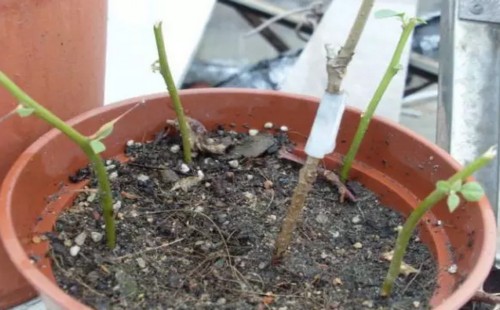
Cuttings are a commonly used propagation method for many potted flowering plants, especially succulents, which use it even more often. As long as everyone can master this basic skill, they can usually successfully propagate the potted plants we want, thereby cultivating ornamental potted flowering plants with very high ornamental value. The same is true for Bougainvillea, but during its cutting propagation of young plants, there are some precautions we need to take seriously.
1. The cuttings of Bougainvillea can be either hardwood or softwood, but when using softwood as cuttings, do not cut overly tender branches, otherwise they will not easily survive. Generally, choose green branches that are semi-lignified to lignified for cuttings, as this makes rooting easier and the survival rate higher.
2. Before cutting branches, the scissors must be disinfected and sterilized to avoid giving pathogens an opportunity when using unclean tools to make cuttings, thereby harming the branches. After all, making cuttings requires pruning, which leaves wounds, and wounds are easily invaded by pathogens.
3. When cutting branches, make sure the cut is smooth and flat, preferably in one clean cut, to avoid torn wounds, which can easily damage other tissues and affect the survival of the cuttings.
4. The branches used as cuttings need to have a certain number of buds and leaves. For large leaves, leave 2 half-leaves; for small leaves, leave 2 leaves and more than one bud. Removing excess leaves can reduce water evaporation, while retaining a certain number of leaves can promote photosynthesis.
5. Before the cuttings root and sprout, they can receive scattered light, while also doing a good job of ventilation and moisture retention. After rooting and sprouting, gradually increase light to promote photosynthesis, and if the air is too dry during this period, spray more water. In the evening, the plastic film can be uncovered for ventilation.
6. After the cuttings survive, in the early stage, the cutting substrate should often be kept moist, and the air humidity should preferably be maintained at around 70%; after 1 month, the growth of the cuttings is basically relatively stable, and watering can be gradually carried out, following the principle of “dry-wet alternation”.
The above are several aspects to note during the cutting of Bougainvillea. Of course, the precautions are not limited to these, and there are still some small details we need to handle well. Only when we carry out the cutting work in a standard and meticulous way can we ensure that the cuttings survive smoothly and continue to grow robustly.