Do corn poppy seeds need to be pre-sprouted before sowing?
Flowers and green plants play an important role in our lives. Many friends like to grow them in pots at home to beautify the home environment, while also enjoying them and purifying indoor air. Even when planted in the ground, they can be used in landscaping and many other aspects, which shows that the use of flowering plants is very wide-ranging. Among the many kinds of flowering plants, the varieties people choose are also highly varied due to personal preferences, the ease or difficulty of growing and caring for the flowers, different uses and many other factors.
The corn poppy (Papaver rhoeas) is a flowering plant with graceful form and rich flower colors. As people gradually learn more about it, it has increasingly become a popular choice for growing. This flower is also very widely used and often becomes an important material for beautification and greening in spring. For example, it can often be seen in flower beds, courtyards and other places, and it is also an important variety used as a potted or bonsai flowering plant. Moreover, corn poppies are mostly propagated from seedlings by sowing, so do corn poppies need pre-sprouting?
For many flowering plants suitable for sowing, pre-sprouting treatment is generally needed to promote germination and increase the germination rate. After all, the seeds of many flowering plants are tightly wrapped inside an outer coat, and some seeds have very hard outer coats that make it difficult for them to sprout on their own, so pre-sprouting treatment is generally needed before sowing. However, for a plant like the corn poppy, although its seeds are relatively small, they usually sprout quite easily. Generally, simply scattering them directly into the soil and ensuring temperature and humidity makes it very easy for them to sprout. So for ordinary small-scale sowing and propagation or home pot sowing, pre-sprouting is generally not needed.
For small-scale cultivation, we usually harvest the corn poppy seeds and, when the temperature is suitable in spring or autumn, sow them directly into the soil. Just pay attention to maintaining suitable humidity, and germination is generally not a problem. Some people have tried soaking the seeds to pre-sprout them, but before they were even used for sowing, the seeds ended up being soaked to rot. Setting aside whether corn poppy seeds can sprout when sown directly, simply based on the characteristic that the seeds do not tolerate water, we know that they cannot be pre-sprouted by soaking.
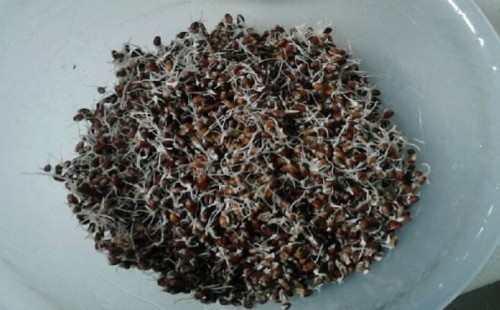
However, although corn poppy seeds do not need pre-sprouting, and cannot be pre-sprouted by soaking, that does not mean pre-sprouting is impossible. Moreover, if it is for large-scale planting and mass production, pre-sprouting treatment is still necessary. But pre-sprouting treatment for corn poppy seeds is often carried out using high temperatures. This is because corn poppy seeds sprout relatively quickly in a high-temperature environment, and the germination rate is also higher. It is worth using light conditions to speed up seed germination. This avoids the phenomenon of corn poppy seeds being soaked to rot when using the traditional soaking method for pre-sprouting.
High-temperature pre-sprouting treatment for corn poppy seeds is generally mostly used for large-scale planting, such as planting them into a sea of flowers, where this pre-sprouting method is very suitable. This is because high-temperature pre-sprouting can give corn poppy seeds a higher germination rate and more uniform emergence, and the later blooming will also be more uniform. Just compare a sea of corn poppies blooming generally at the same time with a scene of only a few scattered blooms, and the ornamental effect is naturally self-evident. So in this case, high-temperature pre-sprouting treatment of corn poppy seeds is completely necessary.