Detailed Guide to Propagating Blue Iris by Division
Blue represents eternity and romance, and also gives a feeling of harmony, freshness and tranquility. In the world of flowering plants, there are quite a few plants that produce blue flowers, and the blue iris is a very typical representative. Moreover, whether used for landscaping or as a potted plant, the blue iris has extremely high ornamental value. Besides propagating from seed, it can also be propagated by division. So, how do you divide blue iris?
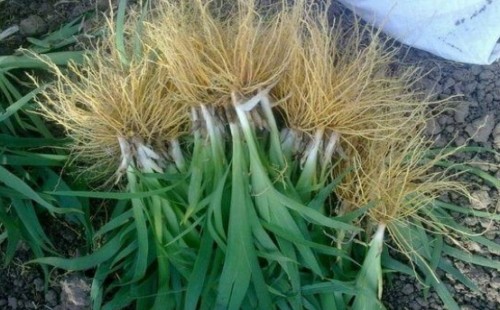
Division is one of the more commonly used propagation methods for the blue iris. Since it is a perennial herbaceous plant, it does not need to be propagated every year. The blue iris can generally be propagated once every 2-4 years, and as long as the temperature conditions are suitable, it can be done in both spring and autumn, and can even be done after flowering. However, it should be noted that division of the blue iris should avoid the plum rain season, so as to ensure that flower bud formation and differentiation are completed before winter arrives, and that it will bloom and be ready for viewing the following year.
When dividing the blue iris, you first need to take the parent plant out of its original pot, then remove the large amount of soil clinging to the root area of the plant, exposing the rhizomes as much as possible, which makes the division operation easier. After removing the excess soil, we can use a sharp blade to cut the rhizomes.
When cutting, make sure each rhizome section has at least 1 bud; ideally each section should have 2-4 buds, since if one bud is damaged there will still be spare buds to use. Keeping a certain number of buds on each rhizome is very important, because this is the key to producing young potted blue iris plants. When cutting, try to do it in one clean motion to avoid causing secondary damage to the rhizomes, which would affect their survival and sprouting.
Of course, division should also be decided according to the specific situation, and the rhizomes should not be divided too finely, otherwise it may affect the flowering effect the following year. In practice, some of the leaves on the upper part of the plant should be cut off in advance, leaving about 20 cm of height, which can greatly reduce water evaporation. When planting, you also need to control the spacing of the divided plants properly, generally maintaining about 30 cm. But if growing in pots, you can simply plant one divided plant per flower pot.
It is important to note that division is only one step in the process of growing blue iris. How well the divided plants grow later is also closely related to the planting method and growing environment, as well as whether our later care and management practices are scientific and reasonable. To grow blue iris well and let it show itself in its most beautiful form, besides using the correct planting method, the later care and management work must not be done carelessly either!