How to Bend a Cascade-Style Bonsai? A Detailed Guide to Shaping Methods
Cascade-style bonsai generally refers to stump bonsai shaped in the cascade style. Because the stump's form is peculiar and precipitous, and the creative techniques are flexible and varied, a fine bonsai of this kind often resonates with viewers, and cascade-style bonsai can also convey a mood of positive effort and brave struggle. However, the trunk of most cascade-style bonsai is not naturally curved; it is usually the result of deliberate artificial shaping later on. So how do you bend the trunk of a cascade-style bonsai?
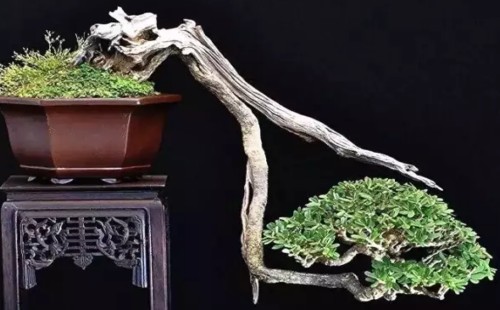
Bending is the most important part of making a cascade-style bonsai. To bend it well, we must first understand the shaping characteristics of cascade-style bonsai, and then use scientific methods to shape it. The shaping techniques for cascade-style bonsai are generally quite flexible and varied, and during the shaping process you must adapt your method to the material. There is generally no unified and strict set of rules to apply, nor is there a single standard, so the shaping process is relatively free and not constrained by various so-called rules.
Usually, when making a cascade-style bonsai, you can boldly create according to the creator's shaping concept, and originally the lower part of the stump is generally left without branches. For ordinary stump bonsai, various shaping effects must satisfy the requirement that the trunk can maintain branches growing on all sides; for the cascade style, however, branches are generally required to grow in three directions. The branches at the lower end of the trunk are often obtained according to the outward growth of the front and back branches and the downward-hanging change in curvature, which can effectively avoid the appearance of shaded branches.
After understanding the shaping characteristics of cascade-style bonsai, we can bend and shape the trunk based on these characteristics. However, if there is a stump with relatively good natural conditions, it often takes half the effort. Because some trees growing at the edge of cliffs are constrained by their environment and tend to extend and grow toward the sunny direction and the direction with ample space, and over time they form hanging roots. The trunk will also extend out beyond the cliff, relying on the roots and stem to grip the ground, and the extension direction of the root system is opposite to that of the trunk. Therefore, such stumps are often easier to shape into cascade-style bonsai.
But aside from the natural cascade advantage of the stump, we also need to use certain techniques to reinforce it so that the bending better conforms to aesthetics. The simplest method is to use metal wire wrapped around the trunk, but if the trunk does not have a natural bending advantage and needs to be bent significantly, then before wrapping it with metal wire, you often need to first use hemp string or plastic tape to do a preliminary bending treatment, and then use metal wire wrapping to strengthen the bent part until it is fixed into shape.
During this bending and shaping process, using hemp string or plastic tape can disperse the points of force and reduce the risk of cracking and breaking. Moreover, even if some cracking occurs, hemp string, and especially plastic tape, can wrap it tightly together and support it, which is more conducive to the healing of the wound in the cracked part, ultimately making the crack disappear completely, so that later on no sign of the previous cracking can be seen at all. This is often an effect that cannot be achieved by using metal wire.
By using two different bending treatments before and after, it can be found that hemp string or plastic tape is mainly used for large-scale bending treatment, while iron wire wrapping is mainly a detail treatment done to strengthen the degree of bending. But the ultimate purpose of both is the same: both are for bending the trunk, letting them play different roles in the process of making a cascade-style bonsai.