How to trim the roots of lucky bamboo grown in water? Detailed explanation of the correct method
Many people like growing lucky bamboo in water, and compared with lucky bamboo potted in soil, its care and management are simpler and cleaner, and it also has extremely high ornamental value. However, because each gardening enthusiast has a different level of experience in planting and growing, the lucky bamboo grown by each household often has its own characteristics, with varying quality and different ornamental effects.
Lucky bamboo freshly bought from the flower market often has not yet sprouted roots, and lucky bamboo is also relatively easy to keep alive. So usually we only need to trim off some leaves to reduce nutrient consumption, and then it can be placed in a container filled with water for water cultivation. However, sometimes we want to dig up plants previously grown in soil for water cultivation, and naturally a large number of roots will appear. With too many roots, water cultivation is not so convenient, so we need to properly trim the roots. So, how do you trim the roots of lucky bamboo grown in water?
To make water cultivation easier, we first need to trim off the roots of the lucky bamboo, but we need to be cautious when pruning. The principle is to avoid cutting off the main roots as much as possible and instead cut off a large number of fibrous roots. In this way, it is easier for new roots to sprout during water cultivation, which is more conducive to survival and growth. Of course, we can also cut off all the roots, including the main roots.
Although lucky bamboo can also survive in water using this method, it needs to go through the process of sprouting new roots. If lucky bamboo without main roots is grown in water, sprouting new roots is usually more difficult and takes longer. Now, let us first look at the operation process.
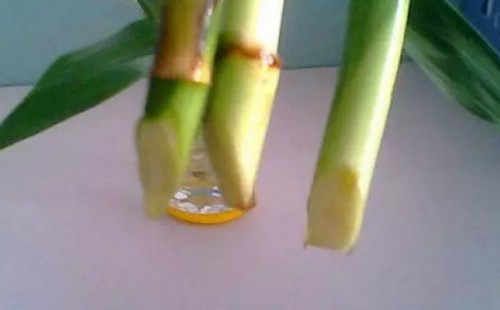
1. First, wash clean with clear water the roots of the lucky bamboo dug out from the potting soil. Then use a knife to cut the base of the main stem of the lucky bamboo into a slanted surface. Note that the cut should be smooth and the force should be even, cutting through correctly in one step. The wound cross-section cut in this way will have a larger area, allowing fuller contact with the water and nutrients in the container, and making absorption, sprouting and growth easier.
2. After about 3-4 days, we need to change the water for the first time, preferably with clean clear water. Of course, to avoid breeding bacteria in the water and causing disease infection, you can put a few small pieces of charcoal in the water. This can play an anti-rot role and avoid breeding bacteria in the water.
3. For the next week or so, try not to move the container holding the lucky bamboo, and do not change the direction of light it receives. After about half a month, we can see white fibrous roots appearing at the wound area of the lucky bamboo grown in water——the lucky bamboo has grown new roots.
4. After the lucky bamboo grown in water successfully grows new roots, we do not need to rush to change its water, nor is it easy to carry out water-changing treatment, because the plant has already adapted to the existing water environment, and changing the water too frequently can easily cause yellow leaves or plant withering. Usually, we only need to wait until the water in the container has evaporated and been consumed in large amounts, and then appropriately add water or replenish water for it.
It should be noted that lucky bamboo originally grown in potting soil, after its roots are trimmed and then grown in water, is equivalent to replanting the plant. However, this planting process is different from the process of changing pots and soil for soil cultivation. Therefore, we need to do well in every step and every detail of the transition from soil cultivation to water cultivation. Only in this way can we promote the smooth sprouting and rooting of lucky bamboo grown in water, and only then can water cultivation succeed.