When to propagate Chinese Bird Plum (Sageretia thea) by cuttings? A detailed guide to timing and methods
Since ancient times, Sageretia thea has been an excellent material for making bonsai, especially suitable for Sageretia stumps, and is one of the important tree species for making stump bonsai. It is also one of the 5 famous trees in Lingnan bonsai. Sageretia bonsai has high ornamental value and good economic benefits, so it has always been well received by the market. Sageretia bonsai can be propagated from small seedlings by means of cuttings, and after the cuttings have stayed in the bed for more than one year, they can be potted and planted. So, when is the better time to take cuttings of Sageretia thea?
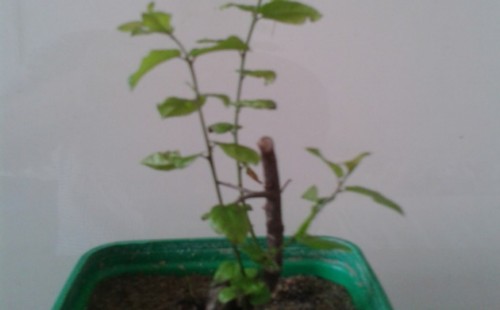
To make a Sageretia bonsai, we first need to obtain the material. For ordinary users, if it is inconvenient to obtain material in the wild, or if it is relatively difficult to obtain stump material in the wild, cuttings are often used to cultivate the material. The cutting time for Sageretia thea is usually chosen in March of spring or during the plum rain season. But even when propagating Sageretia seedlings by cuttings at a relatively appropriate time, we still need to master certain cutting techniques, so that we can hope to obtain relatively satisfactory bonsai material. So, how do you take cuttings of Sageretia thea? Below, please follow the editor to take a look at the cutting method for Sageretia thea.
I. Cutting timing
The timing of Sageretia cuttings often has an important effect on their survival rate, and grasping the accurate cutting time is often the key to the survival of the cuttings. Because our country is vast, the temperature difference between the north and south regions is relatively large, and even within a small area there can be a relatively large temperature difference. When Sageretia thea has completed dormancy and is just waking up, the flow rate of sap in the tree body accelerates and it gradually begins to sprout, so cutting healthy thick branches before sprouting for cuttings often gives the highest survival rate.
II. Cutting the cuttings
The health condition of the cuttings is also one of the important factors affecting survival. In general, healthy growing branches should be cut as cuttings. Such branches often have smooth bark, and the wood core shown at the cut is mostly dark red. If the bark of the branch appears blackish brown, it has often been attacked by pests or diseases, so it cannot be used to make cuttings; even if inserted into the growing medium, it is difficult to survive and sprout. The diameter of the cuttings is best within 2.5 cm, not too large, but also not too slender; the length of the cuttings is preferably kept at 15-20 cm.
III. Cutting method
First, prepare the cutting bed in advance, which requires good drainage, and use moist mountain soil and river sand mixed evenly in equal proportions. After leveling the cutting bed, cuttings can be taken. But to improve the survival rate of cuttings, it is recommended to soak the base of the cuttings in rooting solution for a period of time in advance, then let the excess water dry slightly. Then use a wooden stick slightly larger than the diameter of the cuttings to poke holes of moderate depth in the cutting bed, and gently insert the cuttings from the base into them. Finally, use your fingers to gently press the soil around the cuttings firm.
During the cutting process, it is generally recommended to use moist soil for cuttings, which can avoid watering after cutting and provide suitable humidity to maintain the growth of the cuttings. Also, when cutting, generally do not insert the cuttings directly into the soil without first poking holes, otherwise it is easy to damage the bark at the base of the cuttings and cause secondary injury, thereby affecting survival. Moreover, to improve the survival rate of cuttings, it is recommended to insert bamboo strips into the cutting bed and bend them into an arch to support the covering film. The advantage of covering with film is that it can keep warm and moisturize, and avoid excessive evaporation of water.
IV. Management after cutting
After completing the cuttings, it is recommended to choose a sunny day each week to uncover the film and spray once for humidification. If the light is too strong, promptly set up a shade net on the outer layer so that the light transmittance remains at about 50%. If the cuttings are taken in the bright spring month of March, they can generally take root and sprout in about 1 month, and when the sprouted young shoots grow to about 10 cm or more, we can uncover the covering film. Of course, the light also needs to be adjusted according to the light intensity, to avoid the young shoots being wilted by too strong light; at the same time, avoid long-term insufficient light affecting normal photosynthesis. At this time, spraying water also needs to be strengthened, and spraying 3-6 times a day is more appropriate.