What are the precautions for watering bonsai in summer?
Summer is often quite difficult for human activity; after all, the temperature is high, the weather is hot, and the body uses up a great deal of energy. Not only that, even bonsai plants are often affected by the high temperatures and frequently show various signs of poor growth. And caring for bonsai plants in summer is often much harder than usual, especially when it comes to watering, which leaves no room for carelessness. Even when watering, you often need to master a scientific method and must never do it blindly. Today, the editor will share with you the precautions for watering bonsai in summer.
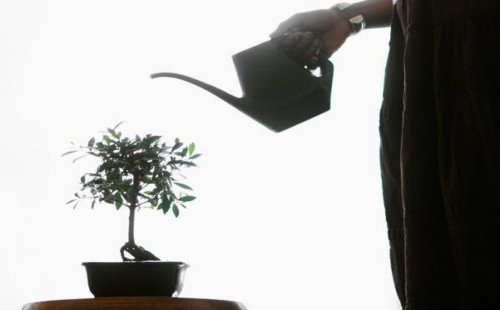
Summer, precisely because of the hot weather and high temperatures, brings a high rate of water evaporation; for human activity this is a test, but for the growth of bonsai plants it is equally a test. How to water bonsai in summer often becomes one of the most critical steps in the care and management process, and in particular the watering taboos among them deserve our full attention. Now let's take a look with the editor at what taboos there are for watering bonsai in summer!
1. Avoid watering during high temperatures
Watering bonsai in summer is a highly technical task that requires deep knowledge, and it must never be done blindly; in particular, avoid watering during the midday period when the temperature is highest. Watering during this period not only causes local instant heat absorption because evaporation is too fast, creating too great a temperature difference inside the pot and thereby damaging the roots of the bonsai plant. The more scientific approach is to avoid the period around midday when the temperature is highest and generally water in the morning and evening, and at the same time combine it with misting, so as to achieve the purpose and effect of replenishing water.
2. Avoid using icy cold water
Using relatively cold water to water bonsai plants is similar to watering during the hottest period of the day; both often suddenly create a huge temperature difference at the roots inside the pot and damage the plant's root system. So, just as you avoid watering during the hottest period of the day, you must also avoid watering plants with cold water that is too low in temperature. The more scientific method is to leave the water prepared in advance for watering bonsai plants uncovered beside the bonsai, letting the water temperature get as close as possible to the temperature of the soil in the pot, and then water with it; this can avoid unnecessary damage to the roots of the bonsai plant caused by too great a temperature difference between the low water temperature and the high pot soil temperature.
3. Avoid using improper water sources
For watering bonsai plants, the water quality of the water source is very important. Original Since most bonsai plants are acid-loving plants, we cannot use water sources with high salinity and alkalinity for watering, and for bonsai plants, soft water is preferable for irrigation. Many bonsai friends are not aware of this, so they often casually pour some tap water directly onto the pot soil, and only after some time, when they find the bonsai plant showing poor growth, do they realize it was caused by an improper water source for watering the plant, thus bringing unnecessary losses. For bonsai plants, the water source is generally rainwater or pond and river water, and if conditions permit, purified water can also be used. If you really must use tap water, then it also needs to be left to stand for a few days in advance, and only used for watering after the chlorine in the tap water has evaporated.
4. Avoid pouring large amounts of water in a sudden rush
When watering bonsai plants in summer, you need to control the rhythm well and not just pour randomly; this is mainly because in a high-temperature environment, suddenly drenching the pot soil with a large amount of water after it has dried out not only prevents the plant from adapting quickly for a time, but may also cause varying degrees of damage to the root system. Moreover, for shallow-rooted plants like the Summer Azalea, watering and drenching with large amounts of water can easily wash the plant's roots out; after all, these shallow-rooted plants are often planted relatively shallowly and are generally also suited to being grown in shallow pots. Plants like the Summer Azalea are not only grown shallowly in shallow pots, but their root systems are also very fine, lacking robust roots, and their roots are relatively fragile; after being drenched with a large amount of water, they are not only easily washed out of the soil but also easily broken.
So, although watering bonsai plants in summer means watering thoroughly, you still need to control the amount of water and the rhythm, generally adopting a slow, soaking method of supplying water, so as to achieve the purpose of watering while being relatively safe.