What are the pruning methods for Satsuki azalea bonsai?
Satsuki azalea, an azalea that blooms in summer, has relatively small branches and leaves, but numerous branches. Combined with its round, neat and attractive crown and its diverse flower shapes and rich colors, it is an excellent material for making ornamental bonsai. However, if you want the Satsuki azalea bonsai to maintain a perfect tree shape while blooming on schedule, pruning work must always be done well. But pruning must not only be done in stages, it must also vary according to the tree shape, and if necessary it should be combined with other care measures. In this way, the Satsuki azalea bonsai will always maintain a good ornamental effect. Today, the editor will share with you the pruning methods for Satsuki azalea bonsai.
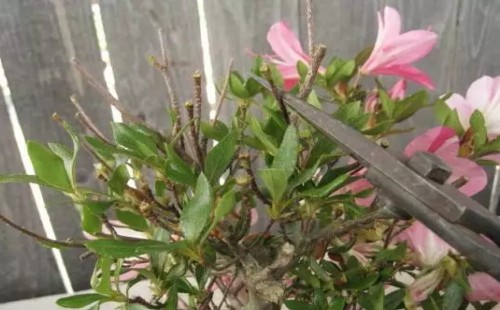
1. Routine pruning
During the growth of bonsai trees, due to metabolism, the replacement of old and new growth, or infection by pests and diseases, some dead branches, diseased and weak branches, leggy branches, and messy branches are often left on the plant. These branches are not only unfavorable for viewing, but also hinder viewing, and to a certain extent inhibit the sprouting of branches and leaves, because these branches will consume a lot of nutrients, thereby weakening the tree's vigor. Based on these considerations, routine pruning should be done regularly, promptly cutting off branches in the above conditions. After cutting them off, the ventilation and light transmission of the Satsuki azalea can be greatly improved, which not only benefits the sprouting of new branches and leaves, but also promotes root growth, thereby restoring the tree's vigor and allowing it to bloom higher-quality azalea flowers on schedule.
2. Styling pruning
In order to create and perfect the shape of the Satsuki azalea bonsai and improve its ornamental value, pruning is often also needed to handle the branches so that the bonsai achieves the best styling effect. Moreover, during the pruning and styling process, adjusting the branches can also improve the tree's growth state, promote growth and development, make the Satsuki azalea grow more vigorously, make the form of the branches and leaves more elegant, and make the overall ornamental effect of the bonsai better. Therefore, pruning often plays an irreplaceable role in the process of styling the Satsuki azalea bonsai.
But if you want to change the overall form of the Satsuki azalea bonsai, then a large-scale pruning treatment will inevitably be carried out. Such heavy pruning work often needs to be done in spring when the Satsuki azalea is in its vigorous growth period, and if the tree's vigor is too weak, heavy pruning must also be carried out. But before carrying out heavy pruning, it is generally necessary to apply sufficient water and fertilizer in advance to promote growth, and then carry it out when the Satsuki azalea has a certain tolerance, so that the damage to the tree body will be smaller and more conducive to the sprouting and growth of the Satsuki azalea. Of course, if necessary, it also needs to be carried out together with measures such as repotting and root trimming.
3. Pre-flowering pruning
Before the flowering period arrives, the Satsuki azalea bonsai generally also needs appropriate branch and leaf pruning. The main purpose is to cut off relatively messy-growing branches and overly long branches, because these branches will to a certain extent destroy the original beautiful shape of the bonsai. After this pruning, not only can some nutrients be saved, but it is also conducive to the Satsuki azalea sending out side branches, especially flower branches, and the entire crown also appears more perfect and natural. This can lay a foundation for later flowering, allowing the Satsuki azalea to bloom more, larger, and more brilliantly. Therefore, it is also very necessary to prune the Satsuki azalea bonsai before flowering.
4. Post-flowering pruning
Generally, after the Satsuki azalea bonsai has finished flowering, it also needs timely branch trimming and pruning. This not only helps maintain the beauty of the original tree shape, but also saves some nutrients to restore the tree's vigor. Moreover, if post-flowering pruning is not carried out in time and those newly grown branches are allowed to grow wildly, the branches will become longer and thicker, which can easily destroy the tree shape, make the bonsai branches and trunk appear very uncoordinated, and also easily weaken the tree's vigor. Therefore, after the Satsuki azalea flowers fade, in addition to removing the faded flowers, it is also necessary to prune the branches in time.
However, for post-flowering pruning of the Satsuki azalea, it is not that all existing current-year side branches and flower branches should be heavily pruned. Generally, for each branch, some new branches with good growth vigor and growth direction should be properly retained. But among the side branches, those growing vertically or in the reverse direction should be cut off, and only the horizontally growing new branches need to be retained. However, if you want to thicken the trunk, these new branches and leaves can temporarily be left uncut. But the post-flowering pruning work is often required to be completed before mid-June in summer.
However, careful bonsai enthusiasts will find that no matter what pruning method is adopted, the tree shape of the Satsuki azalea bonsai will continue to grow larger. In order to achieve the purpose of controlling the tree shape, a relatively large overall pruning of the Satsuki azalea bonsai is generally needed every 3 years. Even flower branches must be properly controlled, thereby releasing more space, which is more conducive to the replacement of old and new branches and leaves, so that the bonsai can maintain an elegant ornamental state for a long time. Moreover, in addition to large-scale pruning, regular repotting and soil changing are also needed to maintain more nutrients in the pot to promote the growth of the Satsuki azalea. This is a very necessary measure for the bonsai to maintain an elegant shape.