A Detailed Guide to the Preliminary Shaping Methods for Tree-Stump Bonsai
Tree-stump bonsai often adopt different shaping techniques depending on the tree species, and the resulting bonsai effects vary greatly as well. Although the shaping methods are not entirely the same, the finished tree-stump bonsai will each have their own merits because of their different forms. However, before making a tree-stump bonsai, you first need to dig up the stump, then after simple processing, promptly carry out root cultivation and growing out. Generally, in autumn you can scientifically prune it to achieve preliminary shaping. Below, the editor will share with you the preliminary shaping process for tree-stump bonsai.
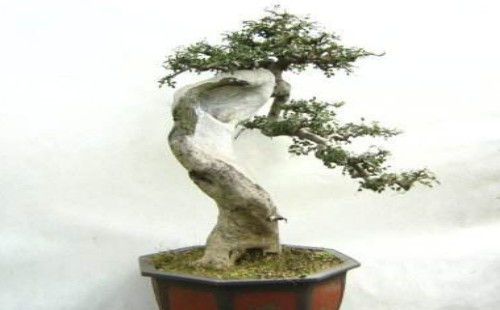
In making a tree-stump bonsai, shaping is a fairly time-consuming and energy-consuming task, and it is also a process that tests the creator's level of mastery of bonsai techniques. Shaping is what gives the tree-stump bonsai a rough prototype with a styling effect, giving it an initial form, and it is the initial stage of the shaping process. Generally, it involves rough handling of the branches and leaves and preliminary shaping of the stump. Among these, pruning and retaining branches, bud rubbing and leaf removal, and preliminary shaping are the most important steps.
I. Pruning and Retaining Branches
After the stump has been dug up and planted until it survives, we need to seize the opportunity to carry out overall shaping treatment on it. This is mainly based on comprehensive consideration of the current natural form of the stump, the creator's design ideas, and the processing and creation needs, retaining healthy branches favorable for shaping at suitable places on the stump's branches and trunk, while cutting off dead branches, diseased and pest-damaged branches, leggy branches, and other branches that are unfavorable for shaping or redundant, so as to avoid these useless branches consuming nutrients in vain. If necessary, some relatively thick branches and trunks can even be shortened by cutting.
Before pruning and retaining branches, we need to determine the development and growth direction of new branches, and promptly cut off excess shoots and buds that sprout out. Note that in the process of shaping the branches, the handling of branches generally needs to avoid using upright-growing branches, so it is necessary to determine which branches to retain. Usually, branches at concave and convex positions on the trunk are more suitable to retain, but symmetrical branch retention on both sides of the trunk should be avoided, and the thickness, size, and density of the retained branches also need to be considered.
II. Bud Rubbing and Leaf Removal
Bud rubbing and leaf removal are relatively important methods used in the process of shaping trees and maintaining a good plant form effect, but they are generally applied to tree species with strong sprouting ability. Especially in the growing season, when water and fertilizer are sufficient, the stump will sprout and leaf out abundantly. If not removed in time, it will not only weaken the tree's vigor by consuming a large amount of nutrients, but also change the plant form. During the shaping stage, we need to promptly rub off the terminal buds on the branches and remove all the leaves. This can not only save nutrients and avoid disrupting the plant form, but also stimulate the tree, promote the sprouting of axillary buds and lateral buds, and produce the branches we need.
At the same time, we also need to cut off the branches and leaves that obscure the trunk and branches to improve ventilation and light penetration, allowing the trunk and branches to stand out. Of course, excessively dense branches and leaves also need to be thinned out to improve the rationality of the spatial layout. Be careful to retain enough remaining space for the later extension of branches and leaves.
III. Preliminary Shaping
In addition to the above two aspects of handling, we also need to carry out preliminary shaping treatment on the bonsai tree. This mainly uses the new flexible lateral branches, and through methods such as hanging, hooking, and pulling, carries out shaping treatment by guiding according to the situation in line with the creator's ideas and design concepts. However, shaping treatment in this case is generally suitable in the evening, because in the evening the branches have better flexibility and are less likely to break during the shaping process.
For the preliminary shaping treatment of tree-stump bonsai, heavy pruning is generally adopted. But it also needs to be handled according to the material, so that the stump's framework is arranged according to the rules displayed by bonsai art, and overall presents an effect of symmetry, harmony, and graceful branches. Moreover, if the tree species is suitable for making exposed-root bonsai, root-lifting treatment can be combined with repotting.