What are the shaping techniques for curved-trunk bonsai?
Curved-trunk bonsai not only have very elegant postures, but also present varied, rich and colorful forms; however, the shaping methods used are all the same, changing in countless ways yet never departing from their fundamental principle. Precisely because of this, we are often required to pay attention in daily life to observing the growth forms of various tree species in nature, to feel their beautiful side through their outward characteristics, and then to express it through the form of bonsai creation. This is where the charm of making bonsai lies.
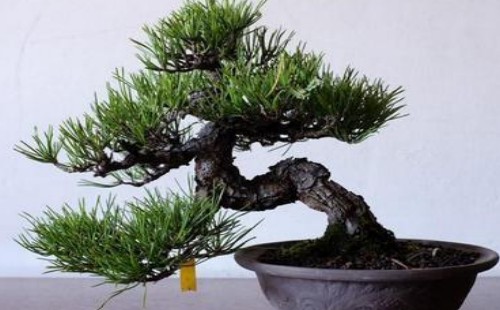
However, relying solely on the tree's original outward form is not enough to meet the bonsai creation effect we need. Therefore, later processing and artistic creation are also very important. If the tree's innate conditions cannot meet the requirements for making curved-trunk bonsai, we can generally use external force to change the trunk's original form and make it deform according to our expected effect. Of course, if a tree has survived in the wild growth environment after being long battered by wind and rain and tempered by the years, it will mostly retain a relatively graceful plant shape. Therefore, for such trees, there is often a greater advantage in bonsai shaping.
To make curved-trunk bonsai, the main goal is to make its trunk and branches present a curved, changeable state, while at the same time showing a natural, ancient flavor, avoiding obvious traces of artificial carving. For tree species whose trunks have a certain toughness, such as Serissa japonica, five-needle pine, black pine, golden larch, and elm, they are relatively suitable for making into curved-trunk bonsai. And curved-trunk bonsai often have relatively exaggerated curved-trunk characteristics in their shaping. Besides possibly being innate, these curved-trunk characteristics can also be achieved through artificial processing and cultivation.
I. Cultivating Young Trees
Sometimes we cannot collect suitable tree species from the wild, and at the same time, from an economic perspective, we are unwilling to spend money to buy them. In that case, we can cultivate bonsai trees by propagating seedlings. But the process of cultivating young trees is often rather time-consuming, especially for seedlings grown from seed, yet building a curved-trunk shape from a young age often gives better results. Generally, for 1-2 year old young trees, metal wire is used to bend and shape the trunk, winding it into an S shape, a coiled shape, or a two-and-a-half-bend shape. But the key point of the operation is to perform crown-finishing treatment on both the side branches and the upper part.
During the process, place the branch origin near the center point of the curved part, that is, at the position where the trunk bulges outward. If there is a deviation in the branch position, it can be properly adjusted and straightened later until it reaches the best ornamental state. Caution is also needed on the issue of crown finishing, which generally falls into 2 situations: one is to create a natural-style shaping effect, through reasonable pruning and properly guiding the top branches and tips; the other is to create a cloud-layer shape, treating the top branches by combining pruning with wiring and bending.
II. Trunk Chopping and Branch Accumulation
Trunk chopping and branch accumulation is a relatively commonly used technique in the process of cultivating tree-stump bonsai. The original idea is mainly to chop the trunk above a first-level branch at a suitable height, while the retained branches should be slanted and drawn. Sometimes a single trunk chop may not achieve the effect we want, so a second or third trunk chop can also be carried out; generally, up to 3 trunk chops are enough, and often the curved-trunk effect we need can be achieved. By adopting this method, the transition often appears more natural than directly bending the trunk.
The shaping method of trunk chopping and branch accumulation is relatively flexible and varied. The trunk can be shaped into an S shape, or into a curved form with a large bend at the lower end and a small bend at the upper end; the lower trunk can even be in a slanted-trunk state while the upper end is S-shaped, and so on. In short, the creative methods are quite flexible and diverse. Specifically, reasonable means must still be adopted according to the original characteristics of the stump bonsai to process and shape it, so that while meeting aesthetic standards it also transitions naturally.
III. Bending Thick Trunks
For curved-trunk stump bonsai, bending thick trunks is also an important technique. After digging up the stump and bringing it back, if we find that the branch growth on both sides of a straight trunk has relatively good quality under a curved-trunk shape, but the trunk is too thick and not conducive to bending and shaping, then we can saw a certain number of cuts at the places that need bending, and then bend it. But be careful to control the depth of the saw cuts, which should preferably be about 1/3 of the trunk diameter. Moreover, during the process of bending the trunk, all protective measures should be taken; cloth strips can be used to wrap it tightly to prevent it from breaking during bending.